

By Sebastian Garcia, from the Spring 2026 edition of Reflections magazine
As the United States approaches its 250th anniversary this July, Central Florida may seem an unlikely place to look for insight into the nation’s history. After all, when Americans think about the founding era, they tend to picture Independence Hall in Philadelphia or battlefields like Gettysburg, not a region best known today for theme parks. Yet Orlando and Orange County encapsulate a defining feature of modern American identity: a social and cultural melting pot shaped by immigration, especially since the late 20th and early 21st centuries.
In 1990, about 51,000 foreign-born immigrants lived in Orange County, or 7 percent of the county’s total population, according to census data and other studies. Thirty-four years later, in 2024, that number increased to about 360,000 foreign-born immigrants, or roughly a quarter of Orange County’s total population. The city of Orlando experienced a similar pattern during this time.
Who are these immigrants, and what are their stories? Most importantly, how have they shaped the history of Central Florida through their influence on politics, culture, and the economy? Drawing on oral histories I collected for the Florida Historical Society’s Library of Florida History, this article highlights individuals whose lives reflect the changing cultural and ethnic contours of Greater Orlando since the late 20th century. By focusing on these narrators, we gain a fuller understanding of people often ignored in the histories of our city and nation, yet who have contributed significantly to both. We’ll begin with Jasbir Mehta of Orlando.
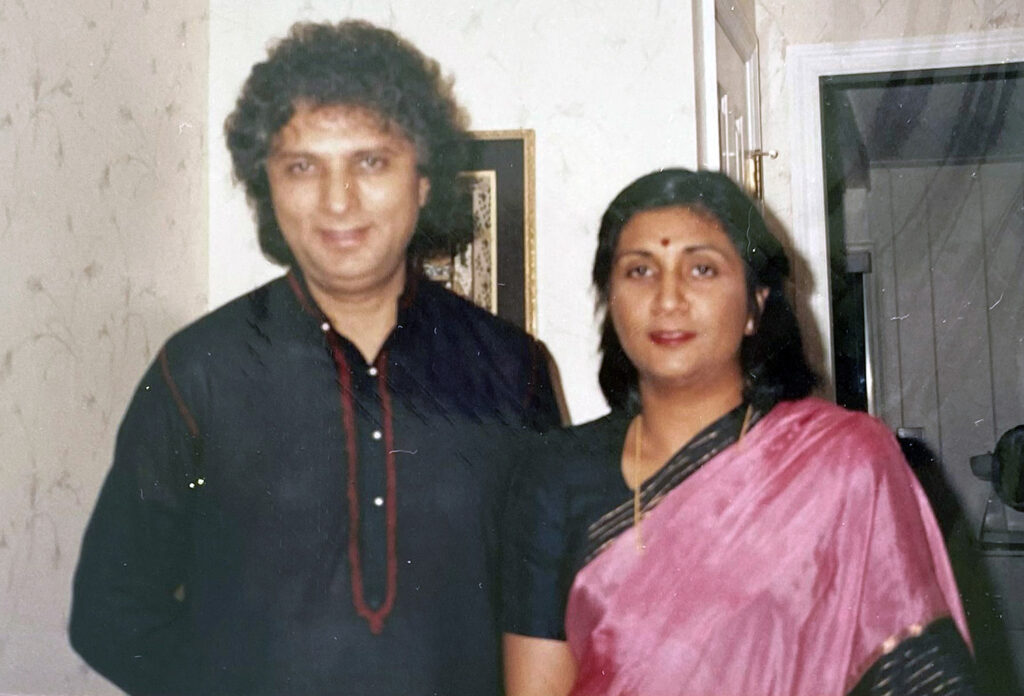
Indian musician Shivkumar Sharma, invited by Jasbir Mehta (right) to perform as one of the first artists featured in ACA cultural programs. Image courtesy of Jasbir Mehta.
Jasbir Mehta
“When I came to Orlando, there was nothing here,” Jasbir Mehta recalled in May 2025. “There were not that many Indians.” Mehta was born in 1955 in Sri Ganganagar, a city in the northernmost part of the state of Rajasthan, India, near the border with Pakistan. She emigrated to the United States in 1976 to pursue higher education at the University of Pittsburgh, as such opportunities remained limited in India for women at that time.
In 1989, Mehta moved to Orlando. That same year, she founded the Asian Cultural Association (ACA) to address the lack of programming in the area that highlighted and supported Indian culture. “If I have to raise my kids and for them to be exposed to the kind of stuff that I grew up with or that I wanted culturally, which I thought the kids should learn, then I have to start this on my own,” she recalled. “And so I invited 17 people to my house, fed them, gave them tea, and asked them to cough up 50 dollars apiece. And that was how I started the organization.”
Mehta initially focused on Indian music, leveraging her connections with musicians and partnering with institutions such as the University of Central Florida (UCF), Rollins College, and Stetson University to expand her reach because, in her view, “you cannot build an audience without the education.” In addition, she invited Indian musicians like Zakir Hussain to sold-out crowds at Orlando’s Beacham Theater and Sanford’s Helen Stairs Theatre.
Mehta also created the first accredited course in Indian music in the state of Florida through Stetson University and later UCF. In 1991, only two years after she founded the ACA, the organization held its first South Asian Film Festival at the Enzian Theater in Maitland. “At that time, there was no forum for independent filmmakers to present their work, which could be sold to distributors. . . . So I wanted to use that as a format that if an independent filmmaker presents his work, then some distributor would want to take the movie on,” she recalled. The event remains the oldest South Asian Film Festival in North America, according to Mehta.
She continued to expand ACA’s programming to include visual and performing arts, while always maintaining the educational focus of these initiatives. “At one point in [the] Seminole County system, we were one of the largest providers of the outreach program,” Mehta noted. “We used to reach twenty [and] thirty thousand kids. And now also we have a program [that] any school calls us to give a presentation, we are definitely there.”
No other organization has hosted more cultural programming aimed at preserving South Asian heritage through education and entertainment than the ACA. As a result, Jasbir has added to the multicultural contours of the City Beautiful, especially for an immigrant group that today ranks among the top ten largest immigrant populations in Orlando – a drastic shift from when Mehta first arrived in 1989.
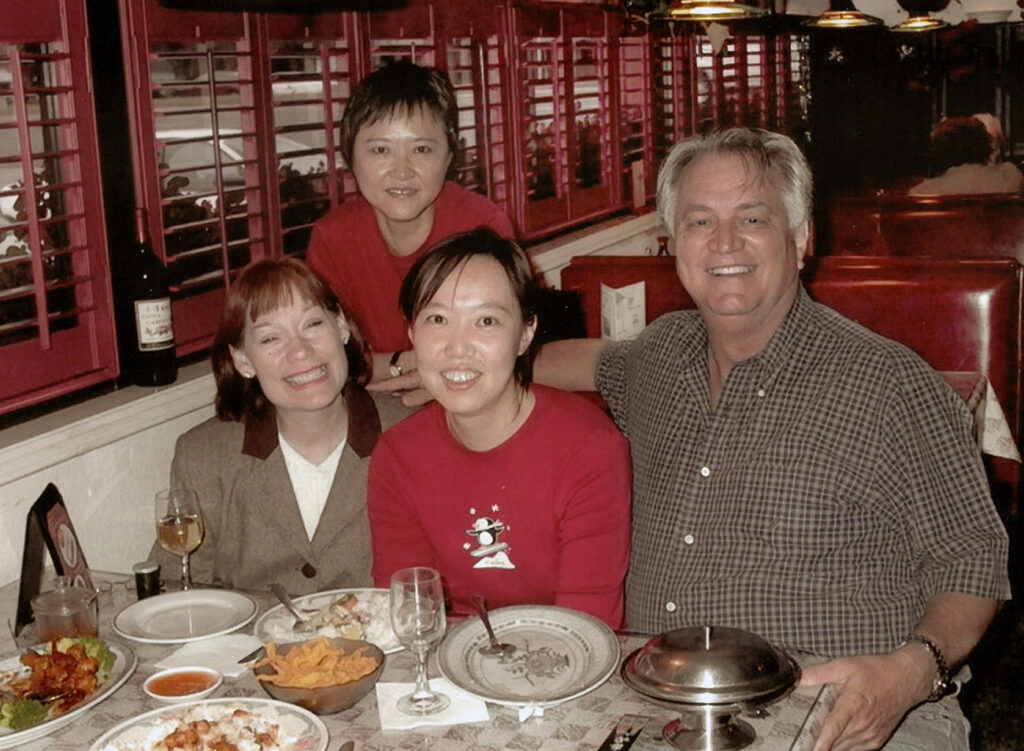
Shally Wong (middle, seated) and Anne Tsoi (middle, top) with China Garden customers in 2003. Courtesy of Shally Wong.
Sisters Anne Tsoi and Shally Wong
Sisters Lai Fai “Anne” Tsoi and Shally Wong also carved out their own spaces in Orlando as immigrants from Hong Kong, preserving their cultural heritage while embracing new life in America.
Born in 1958, Tsoi was the eldest child in a single-mother household and assumed the role of financially supporting the family. She emigrated to Orlando in 1980 to earn more money for her family and found work at Jin Ho, one of the area’s few Chinese restaurants at the time. She and her husband leveraged this scarcity and opened their own restaurant, China Chef, in 1985 at the corner of Goldenrod Road and University Boulevard. Her husband worked as a cook, and she managed the business.
The birth of her son a few years earlier made it difficult to run the business full time. Yet, she had no other choice – she needed to make a living both for her family here and her family back in Hong Kong. Every morning she went to the restaurant to plan the day’s work, she recalled. “I have to buy ingredients because [it was] not a big restaurant. It was about twelve tables, and it was 2000 square feet.
When people would ask Tsoi why she had to keep working when she had her son to raise, she would tell them, “When something [is] facing you, you have to overcome the difficulty. You have to do it. So we worked very hard for the restaurant.” The hard work paid off – she and her husband achieved the American dream of social and economic mobility by buying a house in Orlando and filing paperwork to bring their families, including her younger sister Shally Wong, to the United States.
“I remember my sister send every month 400 [U.S. dollars] to us in Hong Kong, and that 400 meant a lot,” reflected Wong. “She had been working, working, working, so we know we need to work. . . . If you work, you will make a living.” Wong was born in 1969, and with Tsoi’s sponsorship, she emigrated to the United States in 1991. She permanently settled in Orlando in 1999, around the same time that her sister and brother-in-law opened a new, larger Chinese restaurant called China Garden at the intersection of University and Semoran boulevards.
Both Wong’s and Tsoi’s time at China Garden broadly reflected the immigrant experience in Central Florida of finding innovative ways to contribute to local society through culture. Managing a large-scale restaurant with over a hundred seats required Tsoi to host cultural events to attract more customers. “We [thought], ‘what is the way to attract more people?’ We have to do a celebration. . . . If we have some kind of Chinese festival, we would put a little celebration. Like Chinese New Year, we [put] a special menu to attract people, let them book the table, and we even have a performance there in the restaurant,” Tsoi explained.
This transformation of China Garden into an explicit cultural space also placed Wong, who helped her sister manage the restaurant, in conversations with patrons that revealed a lack of understanding of Asian people and heritage. She was able to observe “kind of how little people [knew] about Asian American[s],” she recalled. During her work at the restaurant, she found that many people “tend to ask you a lot of questions that you kind of surprised that they did not know.”
As a result, in 2005, Wong and her husband created Asia Trend, a nonprofit online magazine that promotes Asian American culture by circulating information about Asian American happenings across the state. It remains the first statewide magazine in Florida focused on this community. “That was the time that the population was growing. People want to know more . . . especially with the internet,” explained Wong.
The online magazine’s success contributed to the rise of the Asian American population in Central Florida, according to Wong. One New York couple cited it as the reason for their move to Orlando, for example. “They called me and said they really think that Orlando is really vibrant, especially in the Asian community,” she said. “They really want to move down here because of the magazine.”
Asia Trend has also supported local Asian businesses through advertisements placed throughout the publication. “I have an example that people from California got to buy a business from one of our advertisers,” said Wong.
Her role as a special assistant to Orange County Mayor Jerry Demings, a position she began in 2019, has allowed her to further expand Asia Trend’s cultural outreach. “It is like a dream job for me,” Shally recounted; “I got over 800 contacts in my email list, and many of them are community leaders who have members in their organization.” Through her work in the mayor’s office, her goal is to work closely with more than 30 organizations – work that’s greatly needed, she said, because “there is a lack of Asian American representation.”
Wong’s sister Anne Tsoi joined Asia Trend after she retired in 2017 and currently serves as its president. She remains proud of what her family has accomplished. “I can tell now [that] more people know Asian culture,” she said. “Even when I talked to some of the American[s], . . . they can say Zaoshang, which means ‘good morning’ in Chinese. I feel very happy.” She also describes feeling a greater sense of belonging in Orlando.
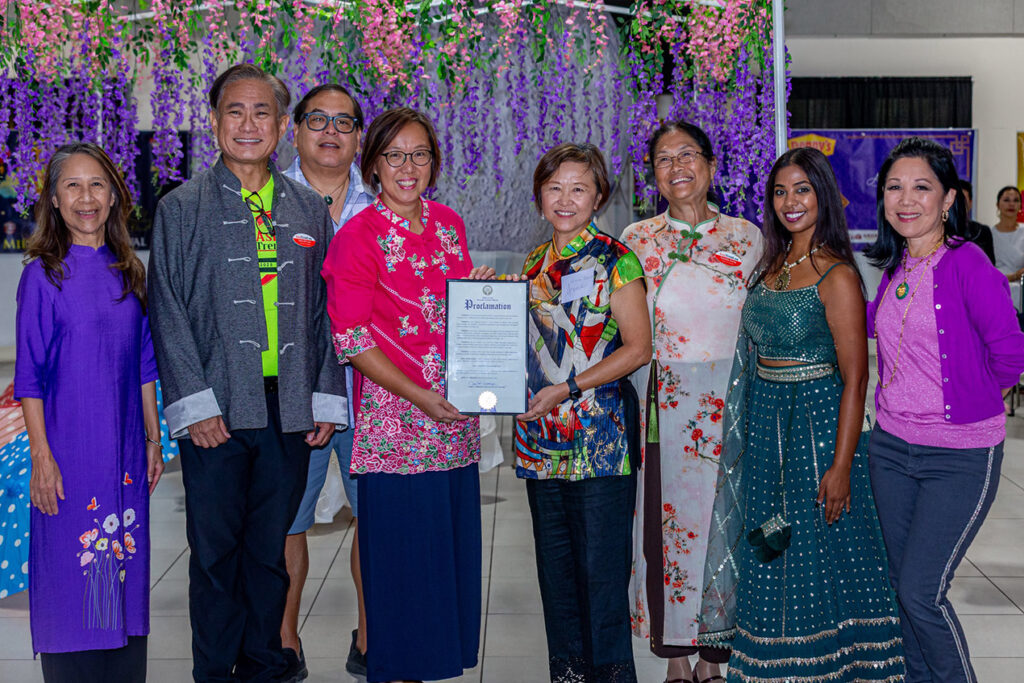
Shally Wong (middle left) and Anne Tsoi (middle right) hold a proclamation celebrating the 20th anniversary of Asia Trend in 2025. Courtesy of Shally Wong.
Janmabhumi and Karmabumi
The life stories of Jasbir Mehta, Anne Tsoi, Shally Wong, and the others in the FHS Oral History Project give us a more holistic mosaic of the varied people who have shaped Central Florida since the late 20th century. Taken together, they embody America’s melting pot. As Mehta eloquently put it, “America gave me the confidence that I could do what I wanted to do. . . . In our culture, we have janmabhumi and karmabumi. Janmabhumi is the earth, the place where you are born. And karmabumi is the one where destiny takes you, where you do all your workings in that. So we always say that India may be my janmabhumi, but America is my karmabumi. This is where I work.
This is where I live. This is where my destiny is.”
Thus, during the time of national remembrance that will come with our nation’s 250th anniversary, we must not view Orlando as a vacation destination or a departure from everyday reality, but as a place that reflects the multicultural and multiethnic lived experience that has shaped America’s history and identity.
Note: To learn more about Jasbir Mehta, Anne Tsoi, Shally Wong, and others, please visit the Florida Historical Society Oral History Project at MyFloridaHistory.org/library/oral-history. The project preserves the life stories of 50 individuals from across 25 countries who have called Central Florida home and have shaped the region’s culture, economy, and politics since the mid-to-late 20th century.