

By Sarah M. Boye
Long before diners enjoyed dessert beneath crystal chandeliers in Winter Park, one of Florida’s most famous apple pies got its start in a family-run coffee shop in Daytona Beach.
In 1932, Isham and Alice Johnston opened Johnston’s Coffee Shop on Magnolia Avenue in Daytona Beach. Like many small businesses of the era, it was a family enterprise. The 1930 U.S. Census places the couple in West Palm Beach, where Alice is listed as the proprietor of a coffee shop and Isham worked as a foreman for Palm Beach County road construction. They remained there through at least 1931 before relocating to Daytona Beach, suggesting that Alice Johnston brought prior business experience with her when the family relocated.
Alice’s mother, Martha Reynolds, supervised the pastry department and developed a reputation for producing homemade pies and cakes that quickly became customer favorites. Reynolds, an Ohio native who had been widowed in 1937 at the age of 70, likely brought with her many of the baking traditions that defined Johnston’s menu.
By February 1939, the family had expanded into a newly constructed restaurant across the street at the corner of Magnolia and Palmetto Avenues. Designed in a modern colonial style, the new building reflected the growing popularity of a business built in no small part on Reynolds’s baking.

Postcard view of Johnston’s Coffee Shop at the corner of Magnolia and Palmetto Avenues in Daytona Beach, constructed in 1939 just across the street from Isham and Alice Johnston’s original 1932 location. Courtesy Orange County Regional History Center.
Behind the growing business, the Johnston family experienced profound personal loss when Alice gave birth to a baby, their first child, who died the same day. In 1937, they opened their home to a 10-year-old foster son, Donald Moore, after the death of his mother. During World War II, Isham’s nephew, Private First-Class Walton Johnston, was held in a German prisoner of war camp. The family began considering retirement and, in September 1944, they leased the restaurant to Detroit caterer Cliff Wishart as they stepped away from daily management.
Financial complications soon followed, and by February 1945 the Johnstons had resumed control of the business, publicly announcing that any debts incurred during the lease were not their responsibility. Only one month later, in March 1945, they sold Johnston’s Coffee Shop to Charles Creighton, a restaurateur from North Carolina who had previously operated Creighton’s Restaurant in Asheville. There, advertisements frequently promoted his establishment’s “green apple pie,” suggesting that Creighton arrived in Daytona Beach with his own ideas about how to market a signature dessert.
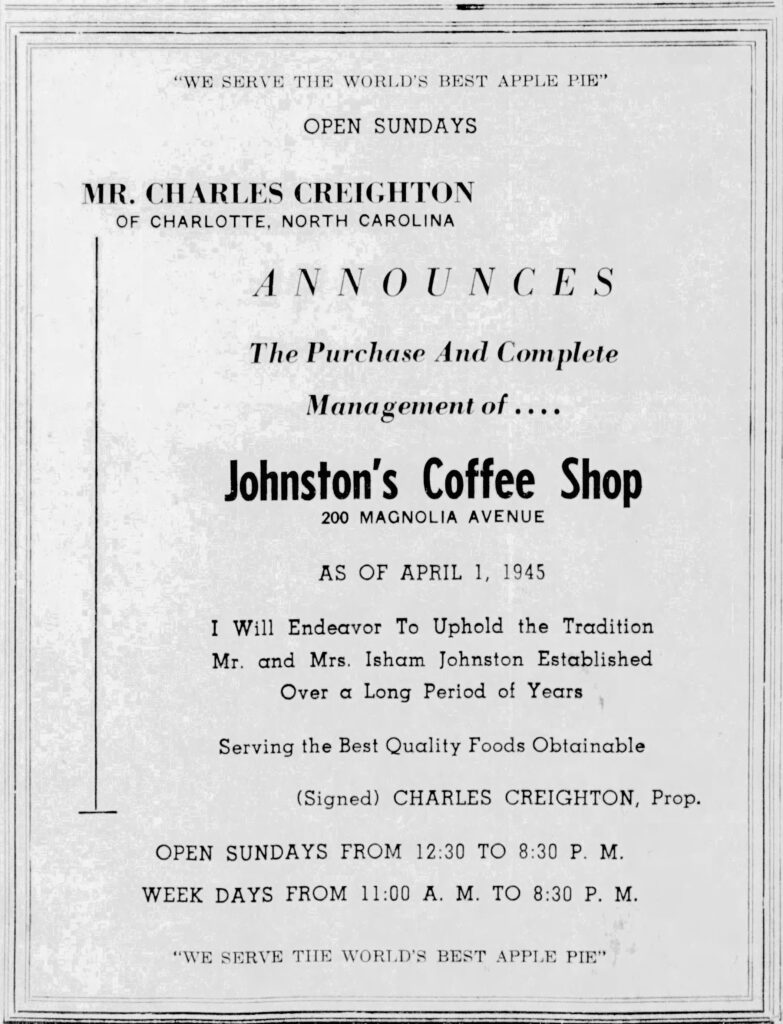
Newspaper advertisement announcing Charles Creighton’s 1945 purchase of Johnston’s Coffee Shop and promoting the restaurant’s “World’s Best Apple Pie.” Courtesy of The Daytona Beach News-Journal.
Under Creighton’s ownership, apple pie began appearing more prominently in Johnston’s advertisements. Within weeks of taking over, advertisements prominently featured the claim that Johnston’s served the “World’s Best Apple Pie.” The phrase would appear repeatedly in his print advertising for decades. By 1947, Johnston’s Coffee Shop was featured in Adventures in Good Eating by Duncan Hines, a popular mid-century dining guide that helped introduce regional specialties to a wider audience.
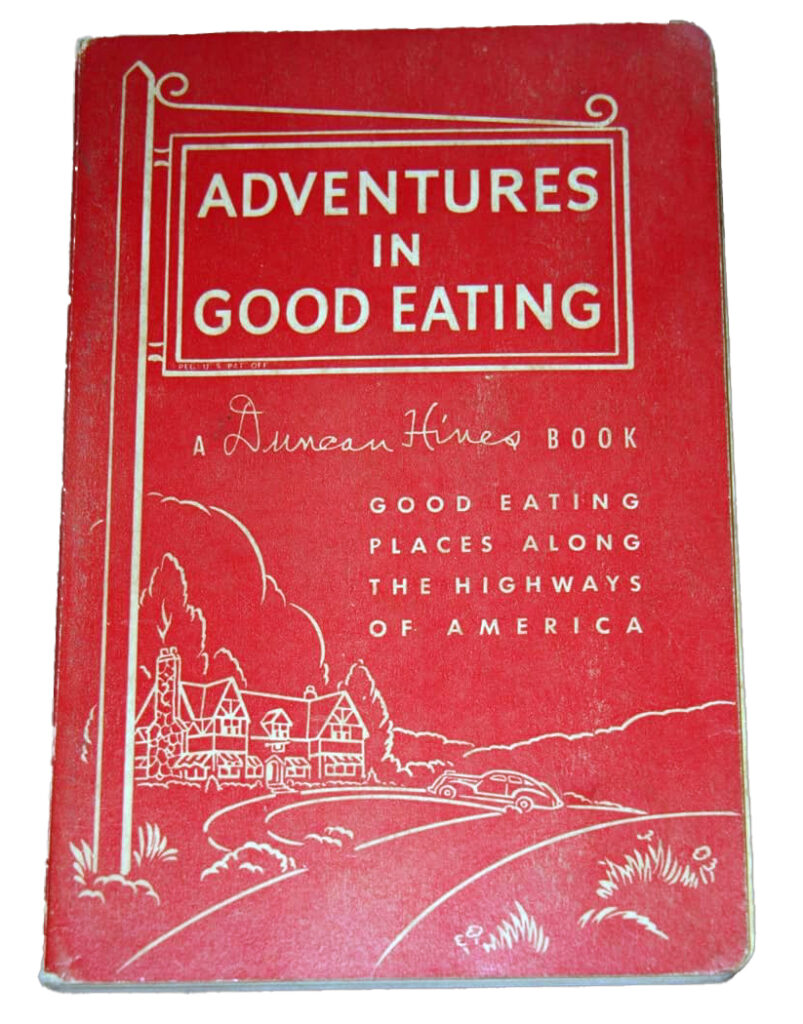
Duncan Hines’s Adventures in Good Eating (1947), which helped introduce Johnston’s apple pie to the world.
As Creighton expanded his restaurant holdings across Florida, the “World’s Best Apple Pie” followed. In Fort Lauderdale, his restaurant became a destination for visitors along Florida’s booming east coast. In Winter Park, Creighton’s Garden Restaurant offered diners in Orange County an elaborate indoor setting complete with an arched glass ceiling, crystal chandeliers, and indoor fountains. Whether in coastal South Florida or Central Florida’s growing suburban communities, Creighton paired spectacle with dessert, positioning the apple pie as both comfort food and his commercial signature.

Interior view of Creighton’s Garden Restaurant in Winter Park, where diners in Orange County could enjoy Johnston’s “World’s Best Apple Pie” in an elaborate indoor garden setting. Esquire Photographers Collection, Orange County Regional History Center.
By 1962, Creighton’s “World’s Best Apple Pie” had attracted attention far beyond Florida when an even more notable guest than Duncan Hines visited Creighton’s Restaurant in Fort Lauderdale. King Saud bin Abdulaziz Al Saud of Saudi Arabia dined with Creighton during his tour of the United States and reportedly requested a glass of warm goat’s milk to accompany his apple pie. However, the restaurant could not provide goat’s milk, and the king settled for buttermilk instead. After dessert, the two men continued their visit aboard Creighton’s yacht, traveling together to Palm Beach. Newspaper coverage of the encounter reinforced the idea that Creighton’s “World’s Best Apple Pie” was not simply a local specialty, but a dish with international appeal.
By the mid-1960s, the apple pie was both a brand and a legend. In 1965, Creighton secured a Florida trademark for the phrase “World’s Best Apple Pie Restaurants,” legally protecting the brand. The recipe itself, however, was never published and was reportedly guarded as a closely held trade secret. But whose recipe was it? Because neither a documented Johnston family apple pie recipe nor Creighton’s proprietary version survives in print, we cannot say with certainty whose version inspired the legend.
While Johnston’s Coffee Shop had long been known for homemade pies under the supervision of Martha Reynolds, early advertisements do not appear to single out apple pie in particular. By contrast, Creighton’s Asheville restaurant prominently promoted its “green apple pie” years before he purchased Johnston’s. Did Creighton refine an existing kitchen tradition? Or did he import and rebrand a dessert he had already perfected? The answer may lie somewhere between domestic skill and commercial strategy.
While the exact origins of the “World’s Best Apple Pie” may remain uncertain, its legacy endures in the flavors and memories it created for generations of diners across Florida. One contemporary source offers a glimpse into the style of apple pie that defined mid-century restaurant dining. In Adventures in Good Cooking, Duncan Hines included an apple pie recipe representative of the style that made mid-century American restaurants famous. Give it a try and judge for yourself whether it’s the “World’s Best.”
Duncan Hines’s Recipe for Apple Pie (1939)
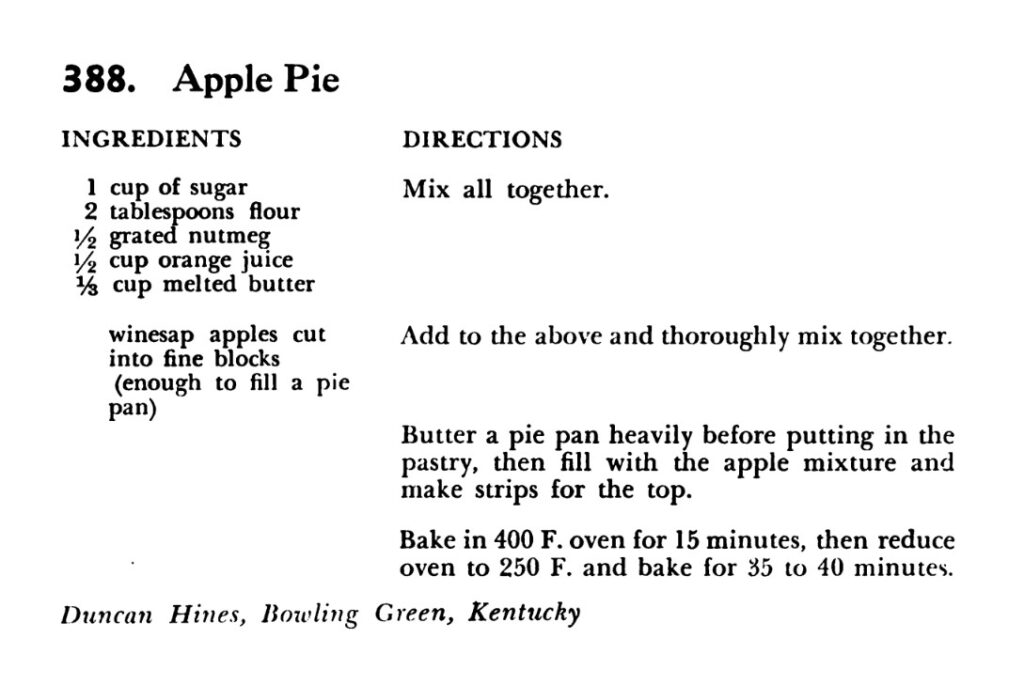 Ingredients
1 cup sugar
2 tablespoons flour
½ teaspoon grated nutmeg
½ cup orange juice
⅓ cup melted butter
Winesap apples, cut into fine blocks (enough to fill a pie pan)*
Directions
Mix sugar, flour, nutmeg, orange juice, butter, and apples together thoroughly.
Butter a pie pan heavily before putting in the pastry, then fill with the apple mixture and make strips for the top.
Bake in 400°F oven for 15 minutes, then reduce oven to 250°F and bake for 35 to 40 minutes.
*Note: Winesap apples are a popular heirloom variety with a firm, crisp texture and a tart, tangy flavor. Charles Creighton’s early pies featured green, or Granny Smith, apples.