

By Peggy Sias Lantz, from the Fall 2020 edition of Reflections Magazine
The year was 1915. The small, hand-built house on the shore of a beautiful lake west of Orlando was the home of David Purdy Sias and his family. It was the first house on that lake and only the second house in the area. D.P. Sias was my grandfather, and his son Ralph was my father.
The lake was surrounded by longleaf pines of all sizes, from grass-stage seedlings and bottlebrush-size saplings to huge, 60-foot-tall old-growth trees. Cattle wandered freely through the woods among the stumps left by lumber cutters and the pines slashed by turpentine companies.
The only roads were deep sand ruts made by cattle and logging wagons winding westward through the trees toward Ocoee and Minorville. Quite a number of people owned cars by this time, but only a horse, bearing a rider or pulling a wagon, could travel the sandy roads in west Orange County. The boards for the Sias’ house were hauled about 9 miles by horse and wagon from J.C. Paul’s lumber mill in Windermere and a mill in Beulah, south of Winter Garden. The wagon had an extendable bed to accommodate the length of the boards.
Going west to go east
Anyone wanting to go to Orlando to the east had first to go west to Ocoee and Minorville to get to the Winter Garden brick road that would take them to town. My grandfather wanted to be able to drive a car to Orlando without first having to go west, scraping by a forest of trees, and getting stuck in the sand. He attended several meetings of the Orange County commissioners, chaired by M.O. Overstreet, and asked them to clear a road. The commissioners offered him the job and gave him a contract, and he agreed to clear an 8-mile stretch, 30 feet wide, that would go past his house on Lake Lucy and take him on a new route to the brick road. The contract specified that he would be paid $100 a mile, if he would wait for his money until the county collected it.
D.P. Sias’ sons, Ralph and Dick, helped their father and the county surveyor, John Otto Fries, survey and mark a route through the woods. It began at the brick-paved Winter Garden Road (now called Old Winter Garden Road) and went north on what is now Hiawassee Road, then west on what is now Silver Star Road. My grandfather hired a crew of Black men and assembled the tools to begin clearing the brush and pine trees.
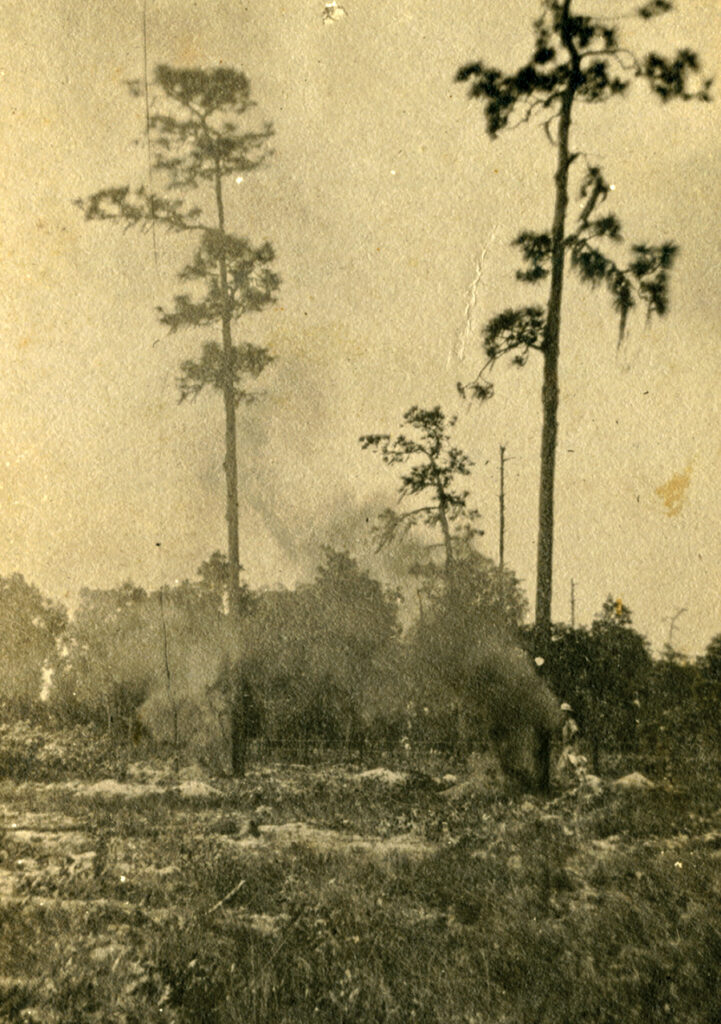
Clearing trees near Lake Lucy, 1914.
Dynamite and machetes
Ralph, my father, was 10 years old at the time; many years later, when I was middle-aged, he told me how the road-building was done. One of the Black workers drilled a hole at the base of each big tree with a brace and bit, making a hole 2 inches in diameter. Then he poked in a stick of dynamite and packed it with sand, leaving the fuse hanging out. When he lit the fuse, he would have about 20 seconds to get away. He would yell “Tree blowin’!” and run back toward the crew.
When the dynamite blew, the entire tree jumped about a foot in the air, then slowly fell over. Branches and pine needles flew in all directions when it crashed to the ground. The crew then leaped into action, lopping the branches off the fallen tree with axes and hauling the trimmings to a huge pile. Two men stood on opposite sides of the tree trunk and used a long saw with handles at both ends (called a two-man cross-cut saw) to saw the pine into lengths that two men could carry to the pile. Other men sawed or chopped down the smaller trees across a wide swath. Machetes cut out the brush.
At lunch time, the men took a break, and the boys, Ralph and Dick, rode a horse named Jim to take their dad his bagged lunch. After work the crew slept in a wagon near the site of the road clearing and were back at work again each day. The workers were paid $1.25 day; their foreman was paid $2.00 a day.
It took 28 days for the trees to be cleared from a 30-foot-wide right of way that was 8 miles long. The brush and stumps were burned in huge bonfires that glowed in the night. Then the county brought a steam tractor with 4-foot-high spiked steel wheels and dragged a blade behind it to level and grade the road.
There is no record to indicate how long my grandfather had to wait for his pay. But he had his road so he could drive his new car to Orlando.
By the end of the 1920s, Silver Star Road was extended beyond Hiawassee Road east to Fairvilla and Orange Blossom Trail. I don’t know when Hiawassee Road got its name, but the banked curve from Hiawassee to Silver Star going west remained until 50 years later when Hiawassee was paved north of Silver Star.
Silver Star was clay during our 1940s trips to Orlando to visit family. My father said in the early days it was scraped almost daily by a mule-drawn blade to keep it smooth, but I remember it as a “wash-board” road with jarring ripples.
On those trips, my brother and I used the lighted star on the top of the sanitarium on West Silver Star Road to know when we were nearing our grandparents’ home, and we thought that the road was named for it. But my father said it was named when the rural mail route began. Mail was taken by a private carrier between post offices, and letters were delivered to the houses at Lake Lucy and other rural areas by the carrier as he traveled from one post office to another. These routes between post offices were called star routes and designated by an asterisk in postal publications.
Life at Lake Lucy
This account is from tales that my father told me, years after he helped survey the new road when he was only 10. He also told stories of milking the cows, encounters with rattlesnakes and alligators, and of his adventures climbing the tall pine trees, of swimming in the lake, and of driving the two-rut dirt road to school in Orlando and having to pump up all four tires on the car every morning first.
There were no power lines for electricity. The family used kerosene lamps for light, wood fires for cooking at first, and later a kerosene stove. The iceman brought 50-pound blocks of ice for the icebox. The water in the lake was clear and clean and was used for washing, cooking, and drinking. The boys fished, and the family ate what they caught. They had a garden. An outhouse in the woods served as a toilet. They built fences to keep the free-roaming cattle from getting in the garden and in the yard. Ralph and Dick wore knickers or bib overalls, and their mother wore long dresses that she sewed for herself and their sister.
When other people, who were mostly friends and relatives from Iowa, built houses on Lake Lucy, Ralph and Dick maintained paths from house to house. Ralph strung telephone wire to each house, too. The telephones were battery operated, with bells to ring the phones, but ringing a bell drained the batteries too fast, so the bells were replaced with a large tin horn at each house to blow when they wanted someone to answer the phone. Each family had a different signal. There also were signals for help, to call the children home, or to come play tennis.
When I was a child, visiting my grandparents at Lake Lucy was always a very special time. The two-rut sandy roads, the kerosene lamps, and the hand-pump for water were still there. The iceman still came to fill the icebox, and I and my brother would get the ice chips to suck.
And the calls of the Chuck-will’s-widow and the frog chorus sang me to sleep at night. Lake Lucy is still a very special place.
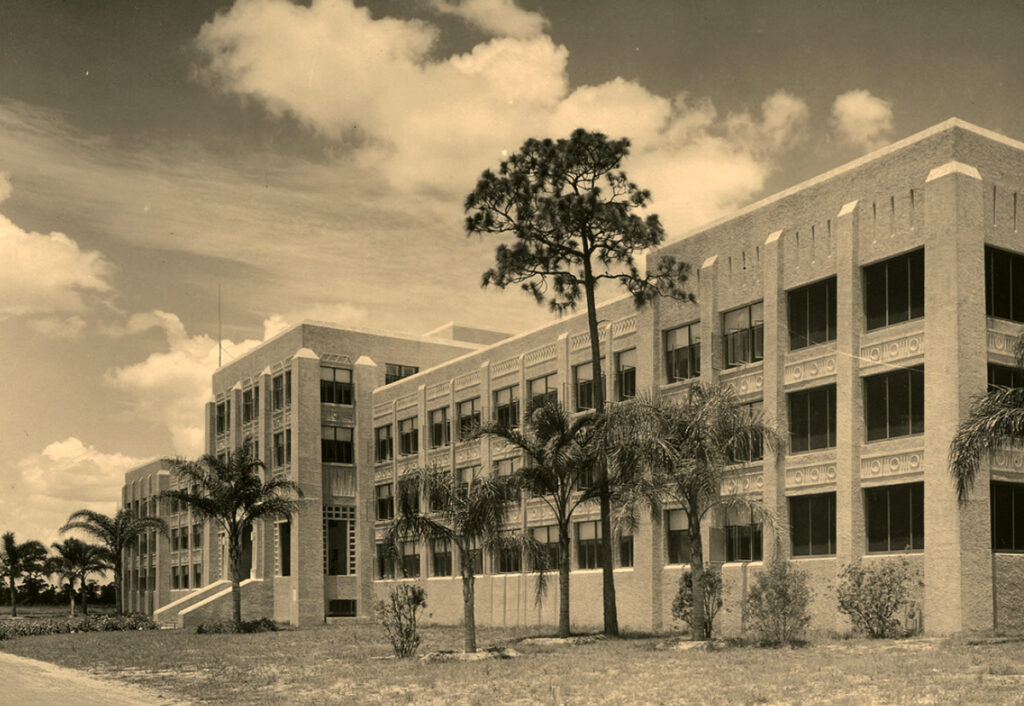
The building at 7500 W. Silver Star Road was the Central Florida Tuberculosis Hospital, the Sunland Training Center for Retarded Children, and the Sunland Hospital of Orlando. The building was dedicated in January 1938 and destroyed in 1999 after years of disuse following the closing of the Sunland hospitals of Florida in the mid-1980s.