

By Cheyenne Stastyshyn from the Spring 2026 Edition of Reflections Magazine
A veteran, community builder, and keeper of history, Dorothy Turner Johnson exemplified a life shaped by service and sustained by purpose.
The year 2026 marks the commemoration of the 250th anniversary of the United States of America. As we approach this milestone to celebrate our country’s endurance, we are also asked to reflect on the people who turned their lives into missions of service, pushing our democracy forward, often unrecognized. One such individual is Dorothy Turner Johnson, a Black woman whose life journey from military service during World War II to community leadership in Central Florida demonstrates how the power of individual actions can inspire collective change.
Reflecting on Johnson’s life and service invites us to consider a question at the heart of America 250: What does it truly mean to be a community member in a democracy still striving to live up to its promise?
Georgia roots and a call to serve
Dorothy Turner Johnson was born in a tiny town North East of Atlanta called Dublin, Georgia, on Jan. 18, 1915. She came of age during a time of racial segregation, limited opportunity, and inequality for African Americans in the Jim Crow South. Her father was an educator, which caused her family to move frequently, following wherever work was available. This brought her family to Atlanta shortly after she was born where her father taught children in their community who did not have access to school because they had to help their families in the fields.
Johnson was one of the few African Americans in her community to gain an education beyond high school. Inspired by her father’s passion for education, she earned a Bachelor’s degree from Spellman College where she majored in French and history in 1938. She received a scholarship, which covered her tuition, and took up a job to support herself through her college career. At the time, opportunities for African Americans were expanding but were still limited. Her upbringing around education and her college career led her to Florida for the first time, where she began teaching 3rd grade in Dade County, Florida. . While her story is one of successes and hard work, she grew up in a nation that demanded loyalty and labor from Black Americans while still denying full access to citizenship rights. In 1941, 24 years before the Voting Rights Act, the world began to erupt around Johnson when Pearl Harbor was attacked. For years, Johnson “lived in her cocoon” at Spellman College and spending her time working at historically Black schools, but when global conflict threatened the future of democracy in 1942, she answered the call to serve.
At 27 years old, Johnson enlisted in the United States Army, joining the Women’s Army Corps (WAC). Her enlistment alone was proof enough of her courage, as Black women faced discrimination not only in civilian life but also within the military. Opportunities were limited for Black women, and respect was not something to be expected. Still, Johnson and thousands of other Black women believed that service could be both a duty and a strategy to claim space in a nation that had long marginalized them.
When the women joined the military, the armed forces weren’t really sure what to do with them. Up to this point, all basic training was geared towards men, even the uniforms were fitted for men’s bodies. There were no specific plans for the training of women.
Bethune and the Six Triple Eight
While courageous, Johnson’s enlistment would not have been possible without the tireless advocacy of Mary McLeod Bethune, an educator, a civil rights leader, and one of the most influential Black women in American history.
In 1904, Bethune founded the Daytona Literary and Industrial Training School for Negro Girls, which later became Bethune-Cookman University. Predominantly In the years leading up to World War II, she recognized that there were many meaningful wartime roles from which Black women were largely excluded. She used her passion and influence to establish the National Council of Negro Women to advocate for the participation of Black women in civic, political, and educational activities.
By 1938, Bethune became the first Black woman to lead a federal agency as director of the Division of Negro Affairs in the National Youth Administration, working alongside First Lady Eleanor Roosevelt to instill these initiatives into the country’s political and social landscape. Through her leadership in what became known as the Black Cabinet, Bethune helped open doors for Black women that had long been sealed shut.
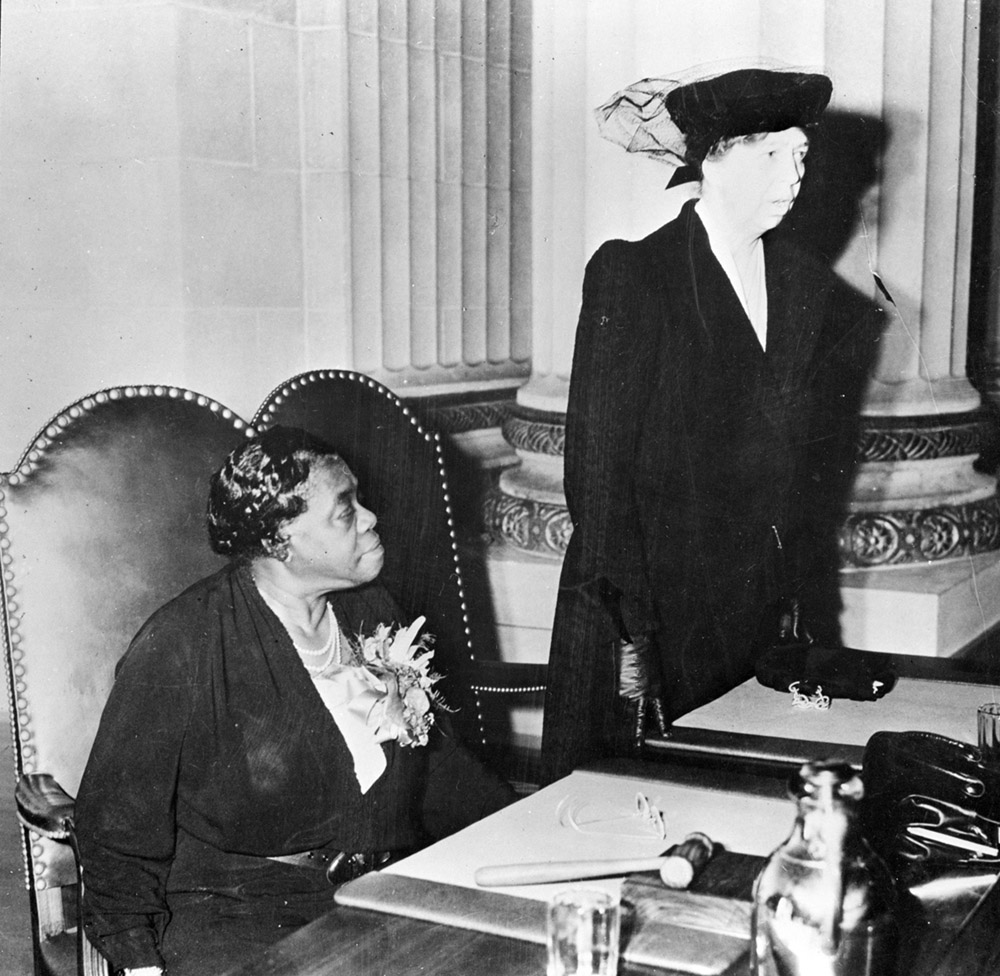
Mary McLeod Bethune, president of Bethune-Cookman College, and first lady Eleanor Roosevelt speak to a National Youth Administration meeting in 1939.
This advocacy paved the way for the creation of the 6888th Central Postal Directory Battalion, known as the “Six Triple Eight.” It was the first and only predominantly Black, multiethnic Women’s Army Corps battalion deployed overseas during World War II. Johnson was among the women who stepped through that door.
Formed to support the Allied fight against rising fascism in Europe, the 6888th Battalion was tasked with a mission that was both daunting and emotionally vital. They were restoring low morale through the delivery of mail. Their motto, “No mail, low morale,” reflected a profound understanding of the human psyche during turbulent times. Letters from home were lifelines, connecting soldiers to the families and futures to which they hoped to return.
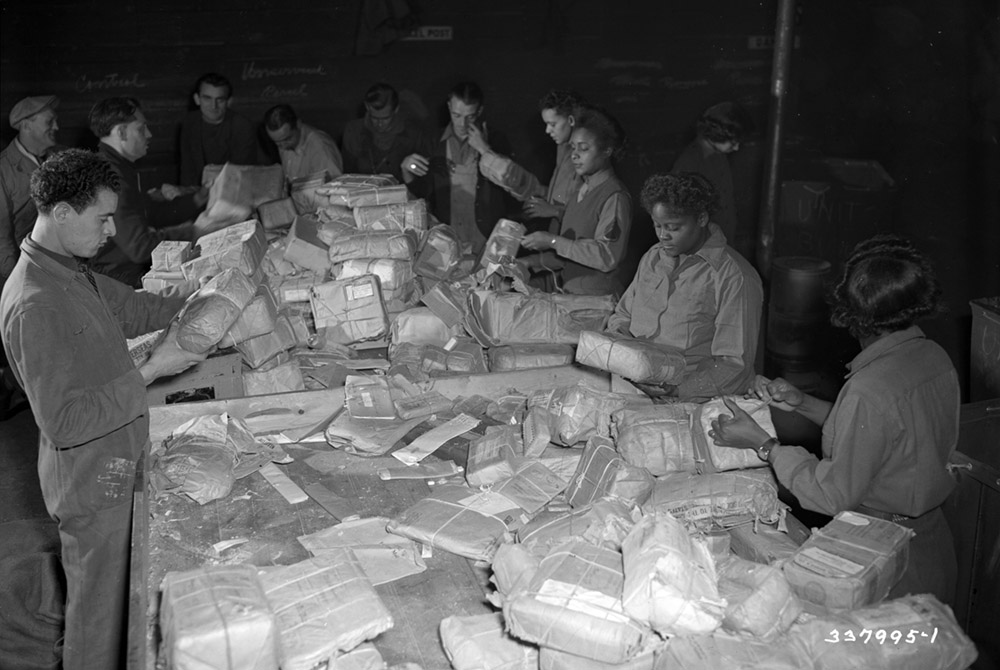
WACs and French civilians sort packages at the 17th Base Post Office, Paris, France, Nov. 7, 1945.
Perilous but vital duty
In March 1945, Johnson and her fellow servicewomen embarked on a nine-day transatlantic journey from the United States to the United Kingdom. The voyage was perilous. German U-boats prowled the waters, forcing evasive maneuvers that emphasized the real danger these women faced, even before arriving at their assignment. They ultimately reached Scotland safely, then traveled by train to Birmingham, England, where the scale of their task became clear. They were housed in an old boy’s school that was cleared out by the military before their arrival. Following their arrival, trucks delivered mail everyday to their station.
Awaiting them was an overwhelming backlog of 17 million pieces of undelivered mail. Many items were improperly addressed, some only bearing first names, nicknames, or common surnames. Much of the mail had been damaged by sitting for so long that moisture deteriorated the letters, and food sent via mail had spoiled and began to mold. This rendered conventional sorting methods useless. Army officials feared the backlog was actively damaging troop morale. Yet, despite the enormity of the challenge, the women of the 6888th were expected to succeed quickly and quietly.
The battalion’s success was the result of ingenuity, discipline, and assertive leadership. When a general attempted to send an officer to instruct the women on how to complete their work, the battalion’s commanding officer, Major Charity Adams, firmly refused, declaring, “Sir, over my dead body, sir!” Her response symbolized a broader refusal to accept condescension or doubt. The women of this battalion knew that their presence marked a phenomenal feat for women, especially Black women.
Johnson and her fellow soldiers devised their own system to address the backlog. They created and maintained a massive card-index system, eventually totaling seven million cards, to distinguish between individuals with similar names using military serial numbers. They worked seven days a week, in three shifts per day, with each shift processing an estimated 65,000 pieces of mail. What was projected to take six months was completed in just three months.
During her time in England, she found that the community of English were accepting of her and her troupe. She remarked that the English were very happy to have the United States Army there because they were helping to defeat fascism. The army was well supplied with fruits that Johnson and her troupe mates would share with the local kids, remembering how the children would ask, “Have you any gum, chum?”.
After completing the Herculean task of organizing the mail backlog, the battalion was sent across the English Channel to Rouen, France, where another backlog awaited; some letters were more than three years old. By October 1945, they had cleared the backlog and were relocated to Paris.
As the war ended, the size of the 6888th was reduced, with hundreds of women discharged by January 1946. The battalion received the European-African-Middle Eastern Campaign Medal and the World War II Victory Medal, acknowledging its contributions to the Allied victory.
Yet, when the unit returned to the United States in February 1946, there was no parade, no public celebration, and little recognition. The battalion was quietly disbanded in New Jersey, and its members returned to a country that largely overlooked their service.
This experience reflected a broader reality faced by Black veterans. During the war, African American leaders promoted the “Double V” campaign, which was victory over fascism abroad and victory over racism at home. While the first victory was achieved, the second remained out of grasp. Many Black veterans encountered indifference or hostility upon their return from military service. This renewed people’s determination to challenge inequality within American society.

A screen capture from Dorothy Turner Johnson’s oral history in the Library of Congress.
Service continues in Florida
For Johnson, her time spent in education and her time spent in the service were interconnected. She is remembered as a lover of art, culture, travel, and of course, education. After her disbandment she took advantage of the G.I. Bill, which assists veterans with earning a college degree. She began a graduate program at Case Western Reserve University where she was studying French. She worked part time in the childrens library, where she began working with famed librarian, Effie Lee Morris. This chance encounter changed her life. Morris encouraged Johnson to follow her passion for education, service, and insatiable thirst for knowledge by pursuing a degree in library science. Johnson left Case Western and began pursuing her library science degree at the University of Wisconsin where she specialized in children’s libraries.
After retiring from her long career of service, she eventually became one of the first residents to settle in Celebration, Florida, in the mid-1990’s. She was inspired to retire here because of the ideals Celebration, Florida sought to create., In 2002, Johnson opened up the towns first library, a 14 x 14 makeshift storage space, which eventually lead to Osceola County erecting a standalone facility.
The same year, she brought together a group of committed Central Floridians to establish the Central Florida branch of the Association for the Study of African American Life and History (ASALH).Founded originally by historian Carter G. Woodson in 1915, ASALH is dedicated to researching, preserving, and promoting Black history. Johnson’s leadership ensured that African American stories would be documented, shared, and honored in Central Florida. Her work transformed the Central Florida landscape by turning memory and history into an actionable, living resource to serve the community and document the important history being forged by community members.
Her legacy lives on in Celebration through the Dorothy Turner Johnson Branch of ASALH, her personal library being donated to Osceola Public Libraries, and through her scholarship which gives young people the opportunity to attend college. Her dedication to education lives on, and the people who knew her remember her through her zest for life, positive attitude, and kind spirit.
Dorothy Turner Johnson’s life offers a powerful lens through which to reflect on America 250. Her journey reminds us that patriotism is practiced through our everyday actions, like advocacy work, community engagement, and service. Democracy is strengthened by people willing to show up, do the work, and create systems that uplift others. In Johnson’s own words, “A well-lived life comes from what you do. . . . There’s something good about just showing up.”