

On social media, history can be remembered, misremembered, and argued over in real time.
By Sarah M. Boye
On the evening of May 8, 1981, the ground near the corner of West Fairbanks Avenue and South Denning Drive in Winter Park began to collapse. A sycamore tree was suddenly pulled underground as Mae Rose Owens looked on with her dog, Muffin. Over the next two days, the Winter Park sinkhole grew to nearly 350 feet wide and 100 feet deep, swallowing part of a municipal swimming pool, several businesses, a home, and a collection of luxury cars in an event that would become part of Central Florida legend.
More than four decades later, the sinkhole still captures attention. When the Orange County Regional History Center recently shared photographs from the Orlando Sentinel Collection on social media, hundreds of people responded with memories, rumors, questions, and stories passed down through the years.
Some remembered traffic jams. Others remembered watching Porsches slide toward the crater’s edge. A surprising number were convinced that someone died in the collapse. And many remembered it less as a natural disaster and more as the strangest tourist attraction Central Florida had ever seen.
Here’s what the comments revealed and how the historical record compares.
“The photos feel older than they are”
One commenter was surprised to learn the photographs dated to 1981 rather than the 1940s. Much of that confusion comes from the images themselves. While color photography was common by the early 1980s, newspapers like the Orlando Sentinel still relied heavily on black-and-white photography for daily publication and archival purposes. The result is a strange visual time warp where helicopters, Porsches, and 1980s Florida exist in photographs that for some viewers feel far older than they really are.
“It was May 9, 1981!”
Another commenter remembered the collapse happening on May 9 rather than May 8. “You got the date wrong!” the post reads. “It was May 9, 1981. I should know – we got married the day this happened, and we’ll never forget it!”
Technically, both dates are correct.
While the most dramatic destruction unfolded during the day of May 9, contemporary reports show that the sinkhole first appeared during the evening hours of May 8, 1981. The following morning, the collapse rapidly expanded as roads, buildings, and eventually entire sections of property gave way.
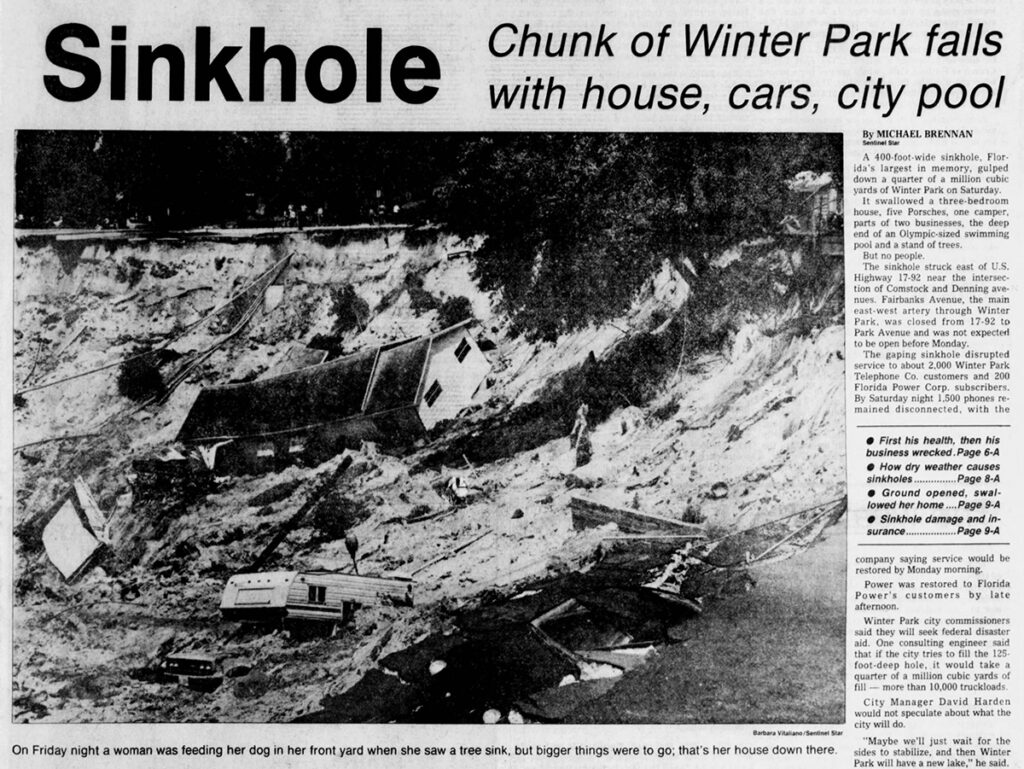
Front page coverage of the Winter Park sinkhole published on May 10, 1981, after the collapse rapidly expanded.
The timing helps explain why many Central Floridians remember May 9 as the day the sinkhole happened. By sunrise that day, the collapse had already become national news.
“I thought someone was killed in it”
One of the most common responses confused the Winter Park sinkhole with later Florida sinkhole tragedies, particularly the 2013 Seffner sinkhole near Tampa that killed Jeffrey Bush.
“Is this the same sinkhole that swallowed a house with the man in it who was never recovered?” one commenter asked, as several others chimed in.
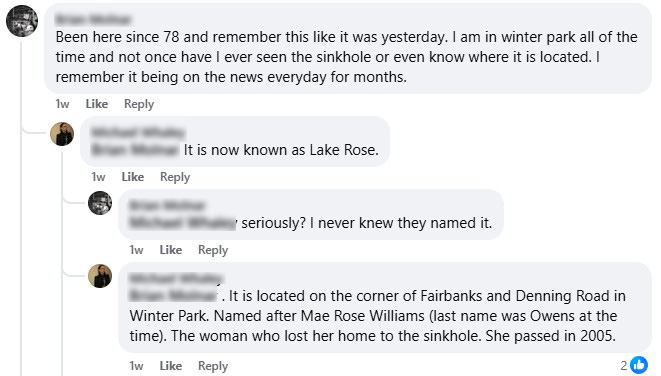
“No, that was years later in the Tampa area,” the first replied. Here’s how the comments went:
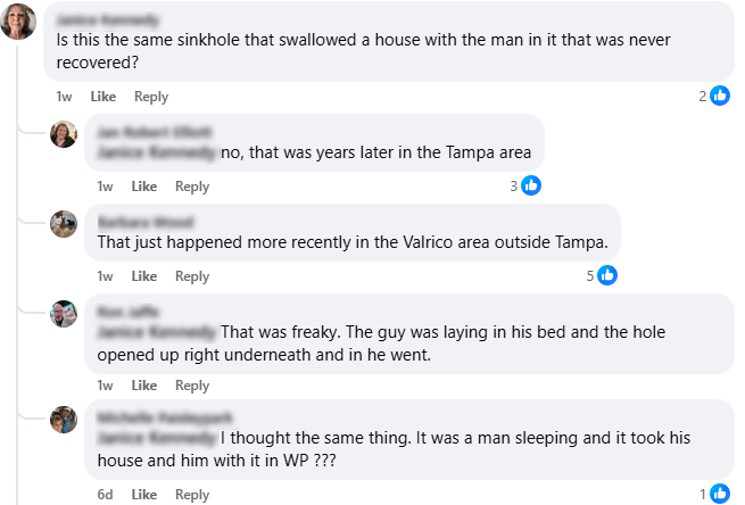
Remarkably, no one died during the Winter Park collapse, but the casualties did include a house and some expensive automobiles.
In the memories of some, the owner of the home barely escaped. “I worked at Ivey’s department store at the Winter Park Mall,” one commenter wrote. “My friends who were working said they felt shaking before it happened. A lady barely made it out of her house and nearly lost her dog chained to a doghouse. It ate a number of Porsches.”
But contemporary reports indicate that Mae Rose Owens, whose house at 900 West Comstock Avenue was eventually swallowed by the sinkhole, had enough time not only to escape with her dog, Muffin, but also to save most of her belongings before the structure disappeared into the crater. Neighbors and family members rushed to help her.
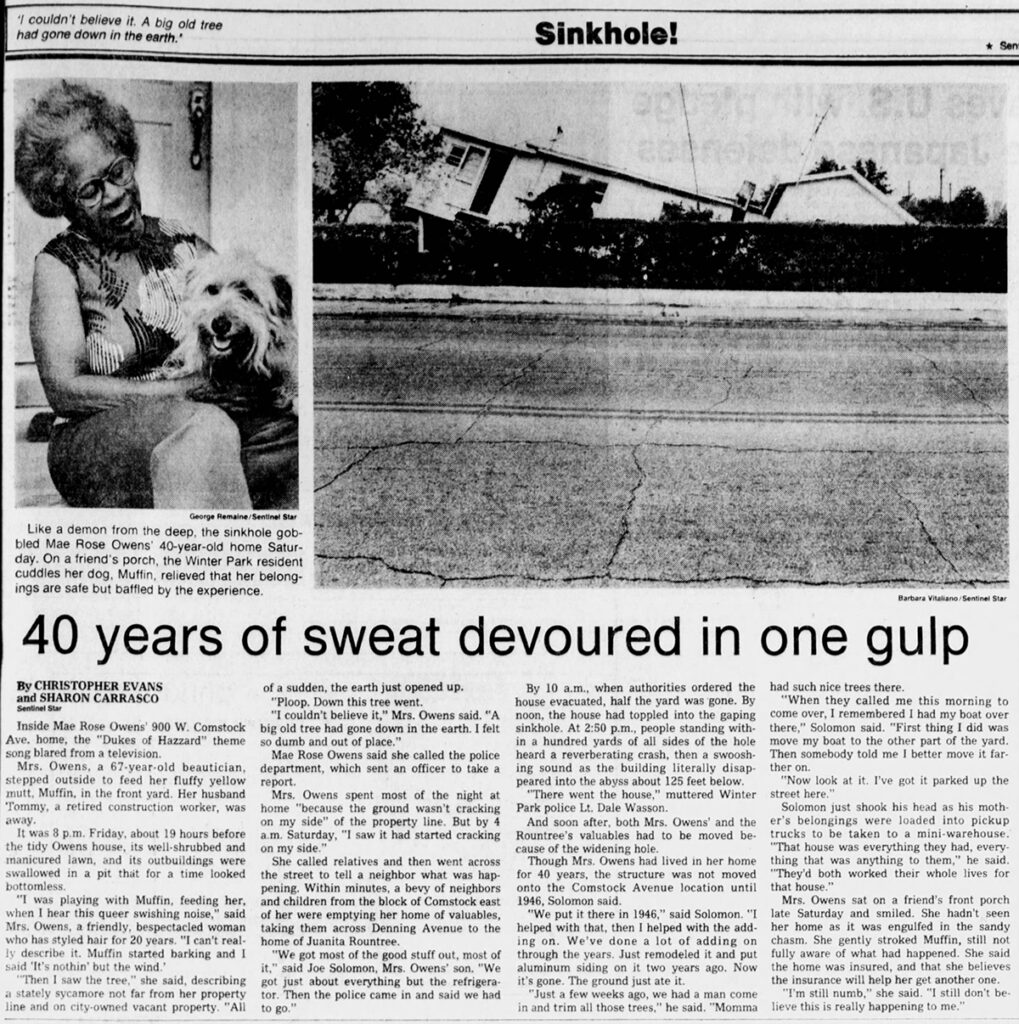
Mae Rose Owens poses with her dog, Muffin, after escaping from the home that was swallowed by the sinkhole. Lake Rose, which later formed at the site, was named in her honor.”
Owens’s dramatic loss likely became part of why the sinkhole lingered so strongly in public memory. For many Central Floridians, the image of an entire house disappearing into the earth felt almost impossible to comprehend.
Today, the lake that occupies the former sinkhole site is known as Lake Rose, named in Owens’s honor.
“I learned to swim there”
For some commenters, the sinkhole was not just the site of a disaster. It was a place where they learned to swim, spent sunny summer afternoons with friends, or even worked a first job as a lifeguard.
“Who remembers the pool that was swallowed up in that sinkhole?” one commenter asked. “I learned how to swim there. My cousin was the lifeguard.’
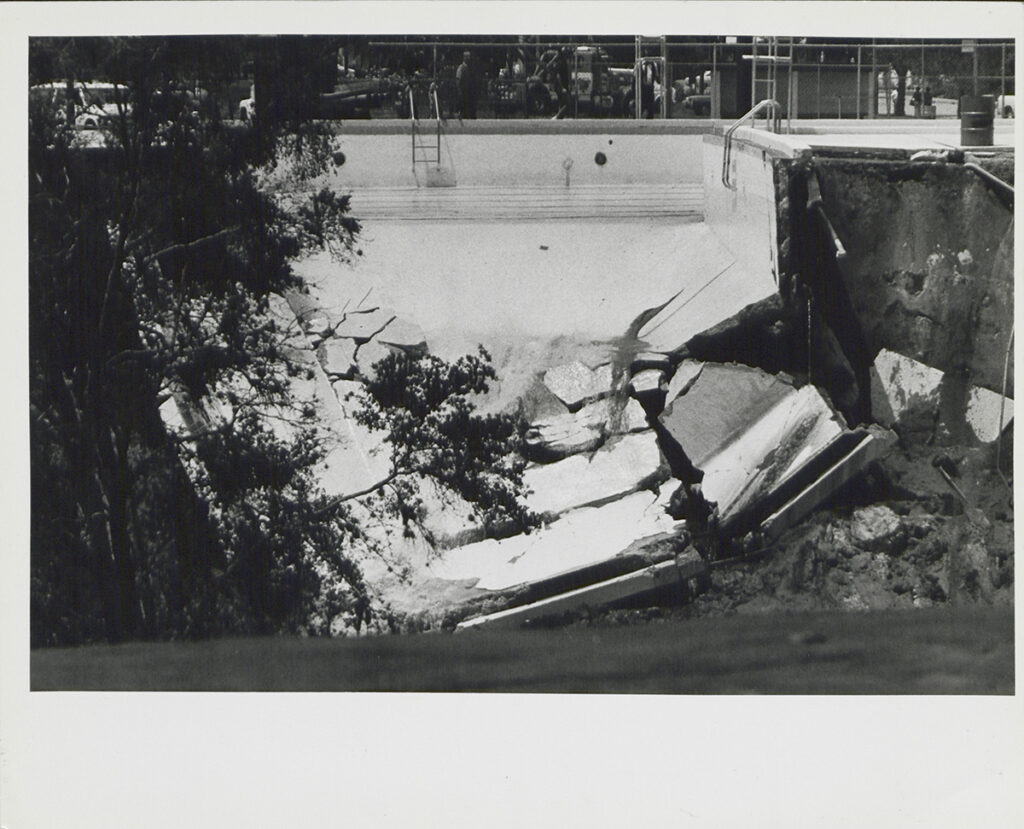
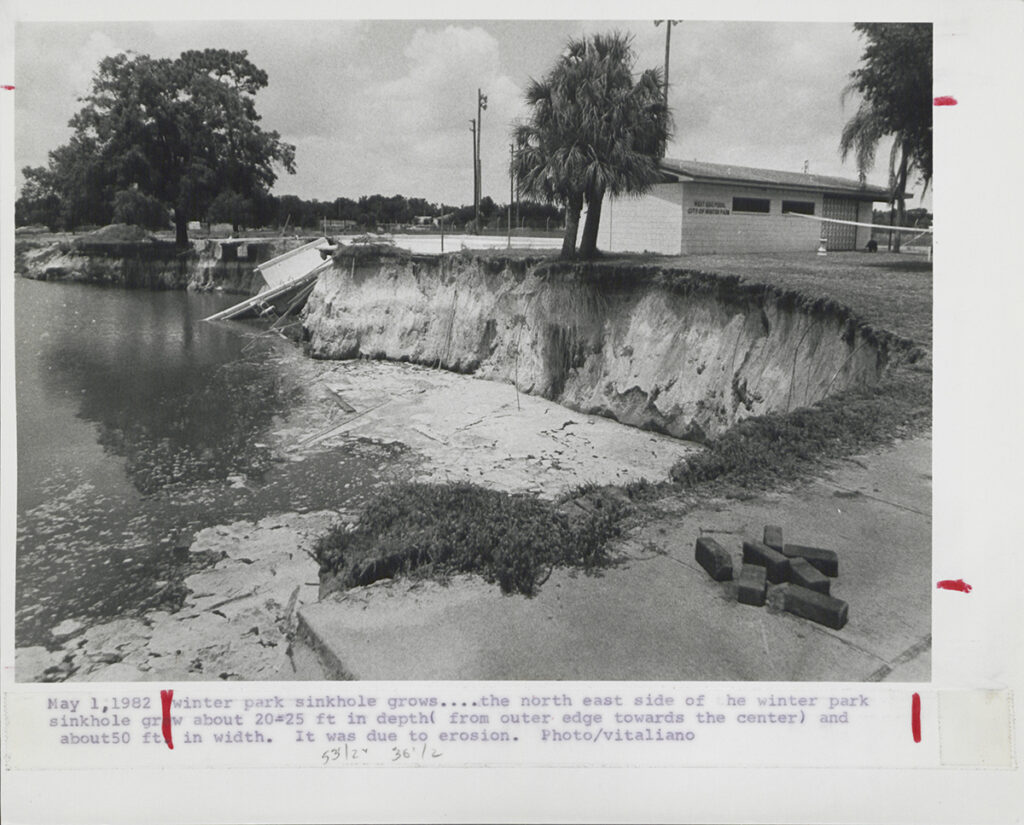
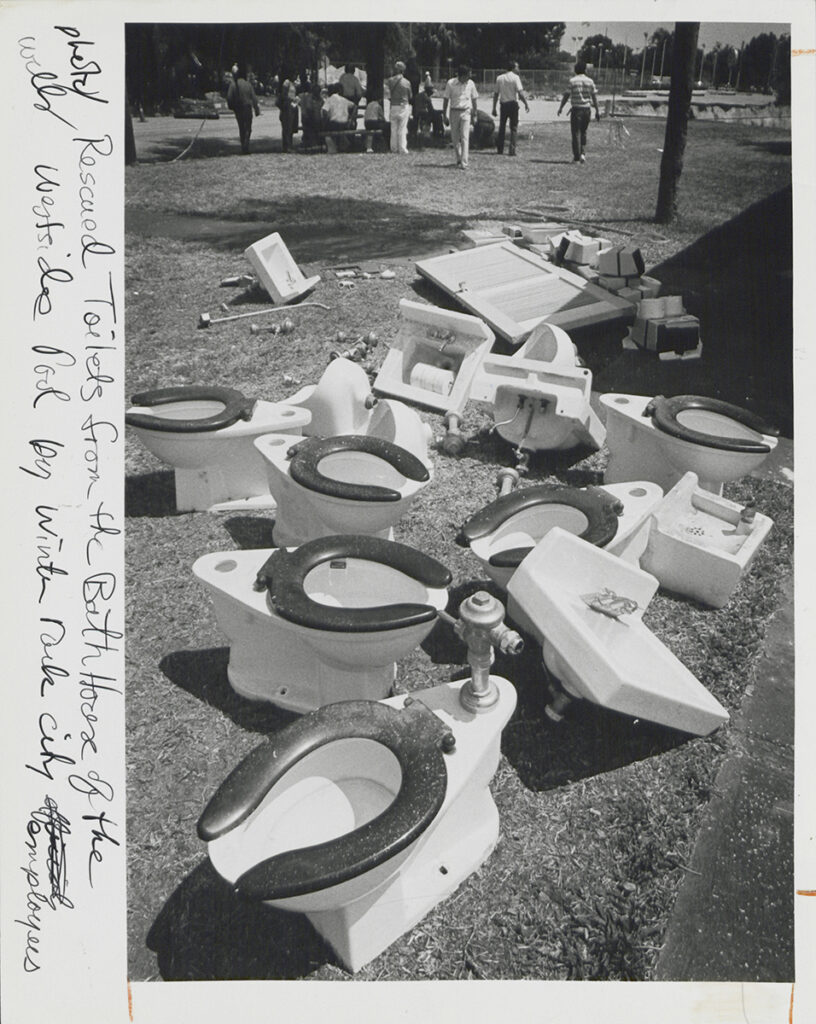
Newspaper photos show damage to Winter Park’s Municipal Westside Swimming Pool following the sinkhole collapse. The deep end of the swimming pool was consumed by the crater, while the City of Winter Park worked overtime to salvage what they could from the bathhouse. Orlando Sentinel Collection.
Part of Winter Park’s Westside Municipal Swimming Pool was destroyed during the collapse. Several people remembered swimming lessons, lifeguards, and family outings at the pool before the sinkhole consumed part of the property.
Those comments reveal something important about how communities remember disasters. Long before it became Lake Rose or “Sinkhole City,” this was simply a familiar neighborhood space where people gathered, worked, and grew up.
“What about the Porsches?”
If the Winter Park sinkhole had a defining image, it was probably the luxury cars teetering along the collapsing edge as crowds gathered nearby to watch the scene unfold. Few events have captured Central Florida’s imagination quite so completely.
“Do you all remember how many Porsches and other expensive cars went in that hole?” one commenter asked. “There was a car repair shop for imported cars that sat right in that area. I think they lost about 10 cars or so.”
“There’s still a Porsche buried in the bottom somewhere,” another added.
The number of cars lost was not as high as ten. German Car Service, located near the sinkhole, lost five Porsches and a Datsun camper truck as the ground gave way beneath the business. The Datsun and three of the Porsches were eventually recovered, though two still remain beneath Lake Rose today.
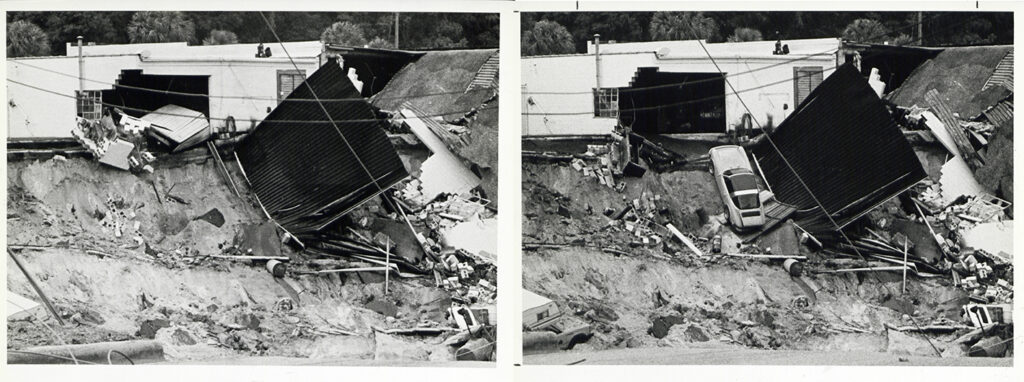
A Porsche is pulled out of the garage and down the steep edge of the sinkhole at German Car Service as the sinkhole expands. Orlando Sentinel Collection.
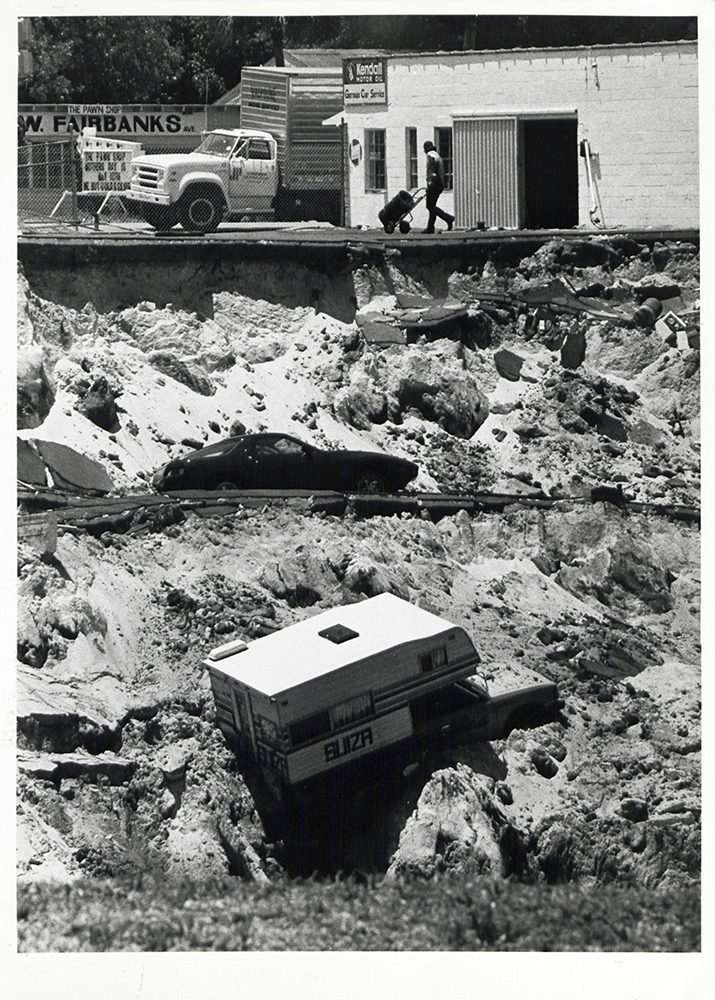
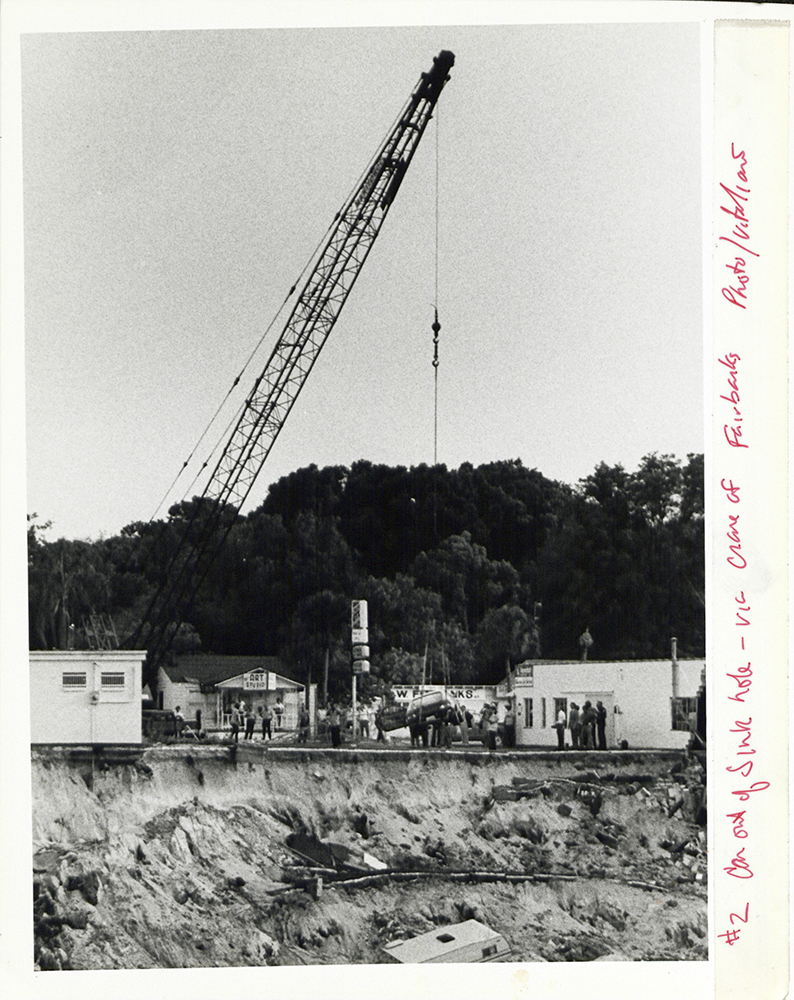
Vehicles and debris from German Car Service sit along the edge of the Winter Park sinkhole as recovery operations begin. Orlando Sentinel Collection.
The recovery efforts themselves quickly became part of the story. “I worked in the control tower just south of the sinkhole,” one commenter noted. “A lot of helicopter traffic back then.” In one especially memorable effort, a helicopter attempted to lift one of the Porsches from the crater.
With helicopters, sports cars, and increasingly bizarre rumors swirling around the site, the whole ordeal felt like something that TV producer Glen A. Larson might have pitched to air on an episode of Magnum, P.I., or Knight Riderduring sweeps week.
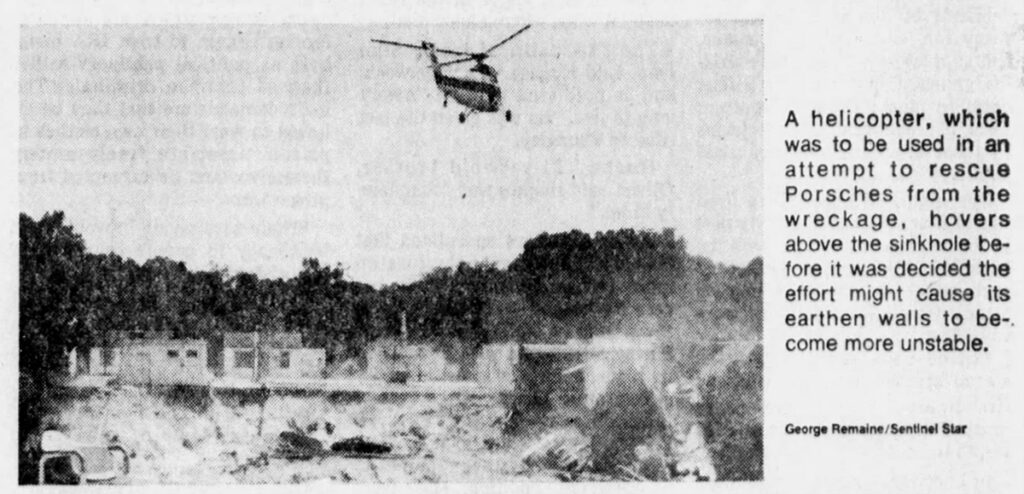
A helicopter hovers above the Winter Park sinkhole during an attempted Porsche recovery operation in 1981. Orlando Sentinel Collection
The infamous vehicle that was the target of an attempted helicopter rescue belonged to Robert “Bob” Govern, whose frantic attempts to recover his 1979 Porsche 928 fueled rumors that drugs were hidden inside the car, which was perched on a ledge in the hole. At the time, his luxury sports car was reportedly worth around $40,000, making it one of the most valuable vehicles swallowed by the sinkhole.
The helicopter attempt was abandoned because of concerns it would add to the sinkhole’s instability, but Govern’s Porsche proved to be the focus of speculation years later. “There was a story a guy lost his Porsche in there,” one recent commenter noted. “He hired a crane to recover it. The city wanted a million dollar bond. He said no problem. The police were there for the recovery. In the car was 500k in drugs and his black book of dealers.”
In reality, no drugs were officially found in Govern’s vehicle during the sinkhole recovery. As for liability, three insurance companies put up $5 million in coverage “for the city and Orange County and agreed to hold neither government responsible should an accident occur during the operation,” according to Orlando Sentinel coverage.
Some of the rumors did not emerge in a vacuum, however. Earlier that same year, Govern had already been connected to a federal investigation after 30,000 pounds of marijuana were discovered after a barn fire on his property. The following year, he was convicted for his role in a large-scale drug-smuggling operation reportedly valued at $300 million and sentenced to 45 years in federal prison.
More than four decades later, stories about the lost Porsches still surface whenever the sinkhole comes up in conversation.
“We went to see it”
As shocking as the collapse was, the public response may have been just as remarkable.
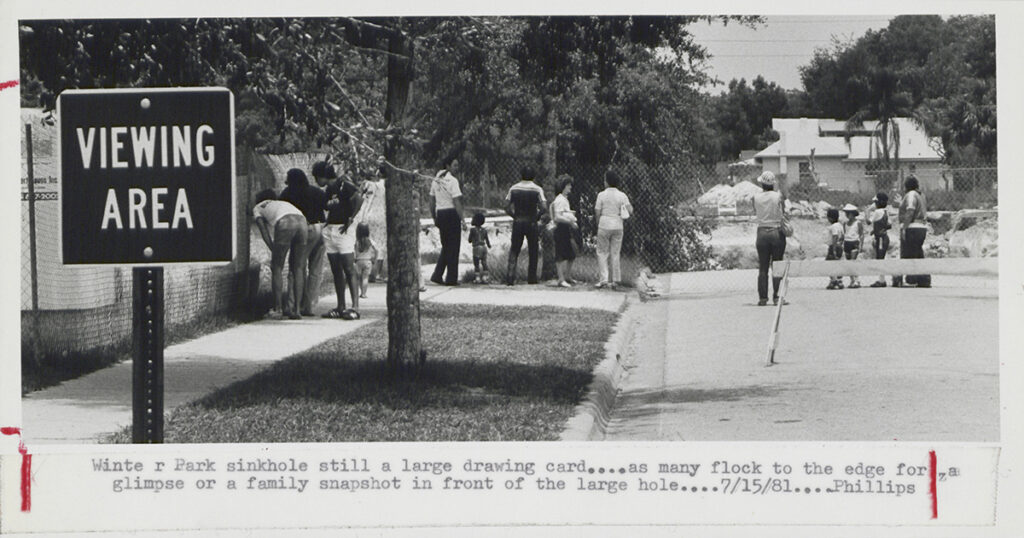
Visitors gather at a designated viewing area near the Winter Park sinkhole in July 1981 after its collapse in May.
Within days, thousands of people were visiting the site to watch the destruction unfold. The City of Winter Park eventually installed fences and designated viewing areas after traffic congestion and distracted drivers became a growing problem. Apparently, even the possibility of the ground collapsing beneath you was not enough to stop people from slowing down for a better look.
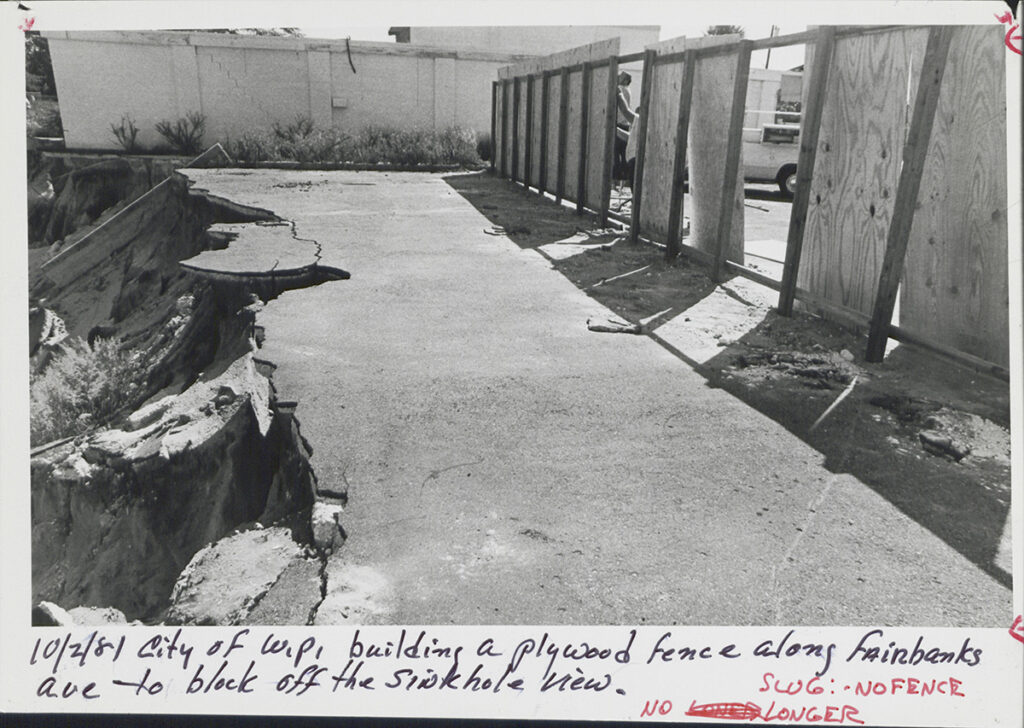
The City of Winter Park constructed a plywood fence around portions of the sinkhole site in October 1981 to discourage distracted drivers and unauthorized access. Orlando Sentinel Collection
Souvenir stands appeared almost immediately. Local businessman Lou Montesi, who owned a nearby pawn shop, began selling “Sinkhole City” shirts and memorabilia to crowds gathered near the site.
“Anyone still have their original sinkhole T-shirt?” one recent commenter asked. “I have a smashed penny with the sinkhole on it,” another reported.
In addition to clothing and pressed pennies, other commenters remembered novelty items, hats, and even a song inspired by the disaster: “Sinkhole City, USA,” by the Riverboaters—available on YouTube. For a brief moment, the sinkhole had become both catastrophe and roadside attraction.
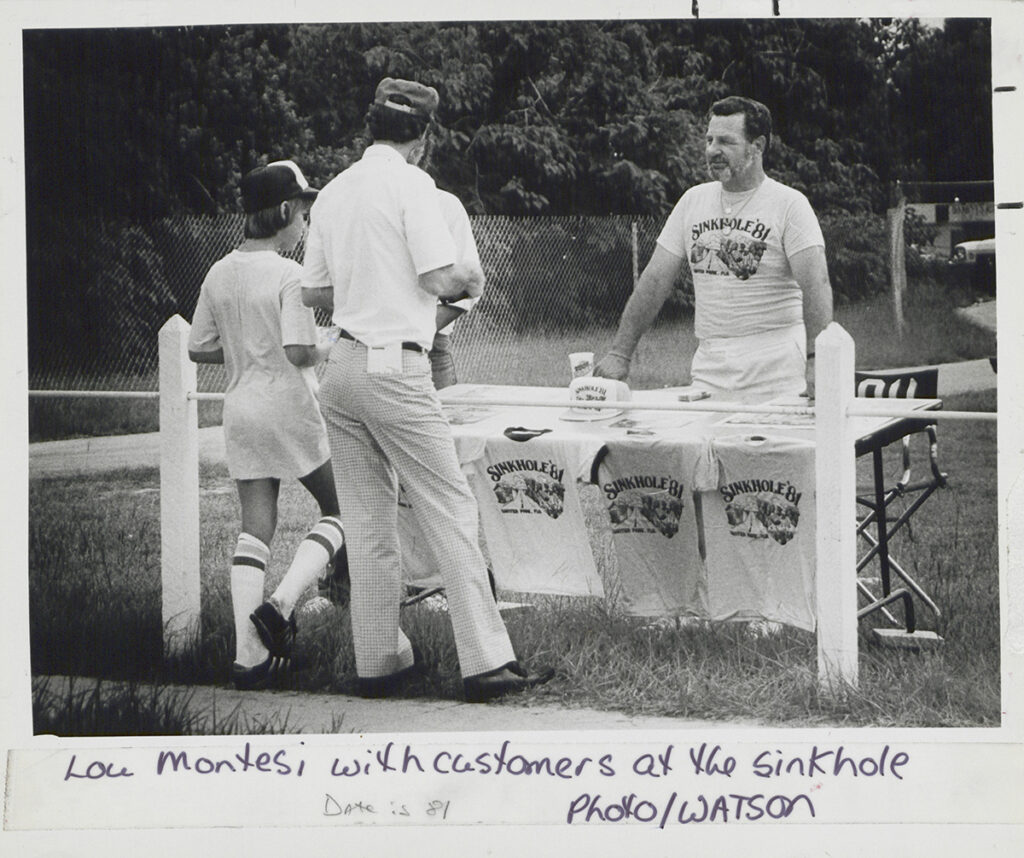
Lou Montesi sells “Sinkhole City” souvenirs near the sinkhole site during the summer of 1981. Orlando Sentinel Collection.
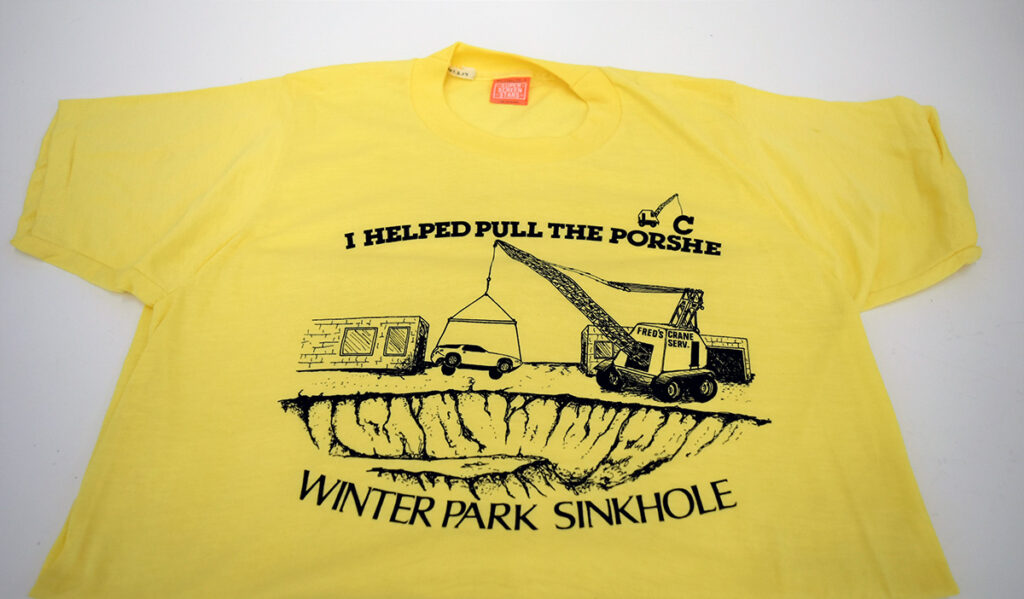
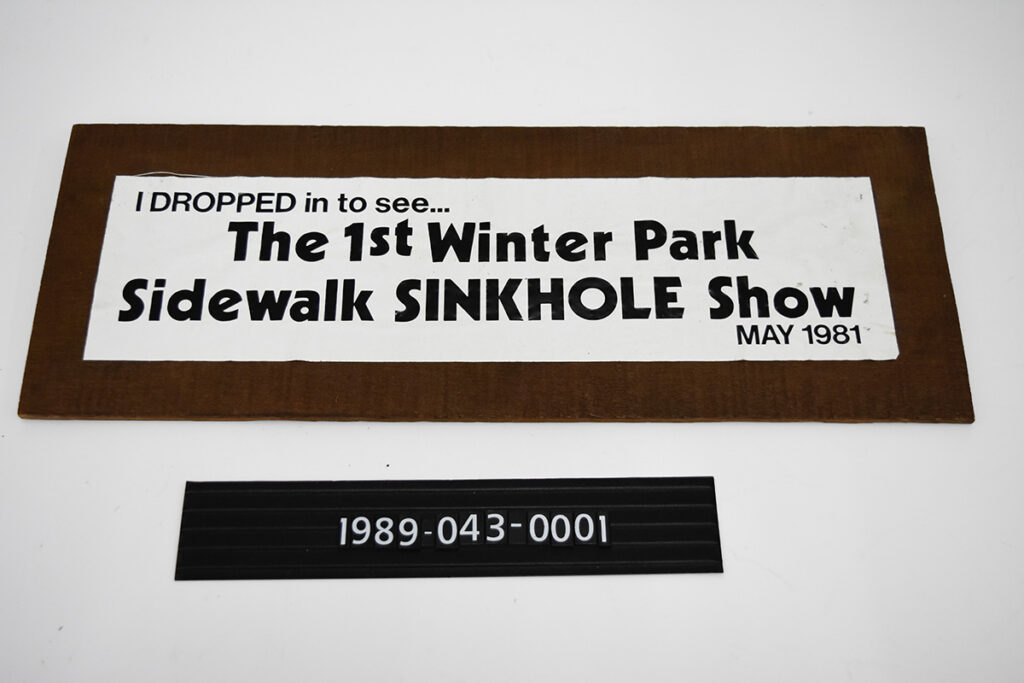
Sinkhole-themed souvenirs, including shirts and memorabilia, reflected the disaster’s rapid transformation into a roadside attraction and local legend. Orange County Regional History Center Collection.
Eventually, the City of Winter Park entered the souvenir business itself, leading Montesi to sue the city over unfair competition. The courts ultimately sided with Winter Park, affirming the city’s ability to regulate and participate in commercial activity surrounding the sinkhole.
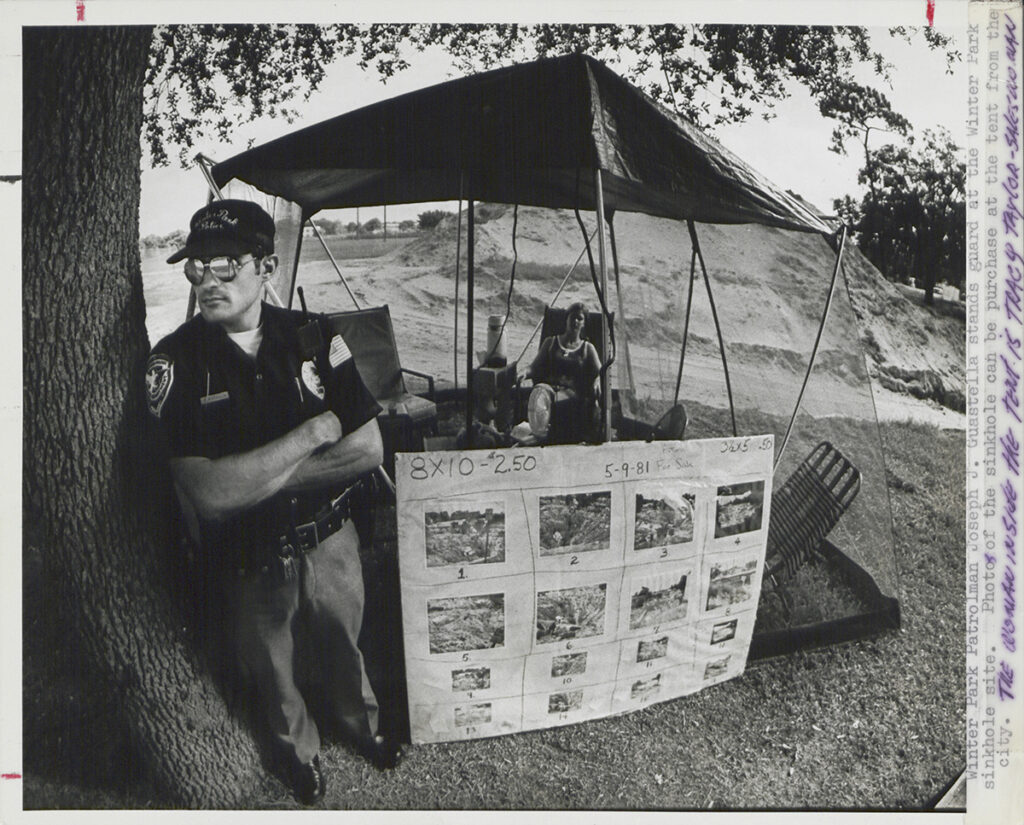
A souvenir stand near the Winter Park sinkhole displays photographs for sale by the City of Winter Park for visitors touring the site. Orlando Sentinel Collection.
The transformation of the sinkhole into a roadside attraction says a great deal about Florida culture in the early 1980s. In a matter of weeks, a natural disaster became a tourist stop complete with souvenirs, photo ops, and its own soundtrack. Only in Florida could a sinkhole develop a marketing strategy before it stabilized.
“That’s Lake Rose now.”
In the years after the collapse, the site slowly stabilized and filled with water. What had once been a disaster zone gradually transformed into what is now known as Lake Rose.
One commenter even recalled participating in an “article dive recovery” at the sinkhole more than 20 years after the collapse, describing it as a “pretty hairy dive” through a lot of loose concrete and rebar—and no Porsche sightings. Even decades later, people are still trying to explore what was left behind beneath the water.
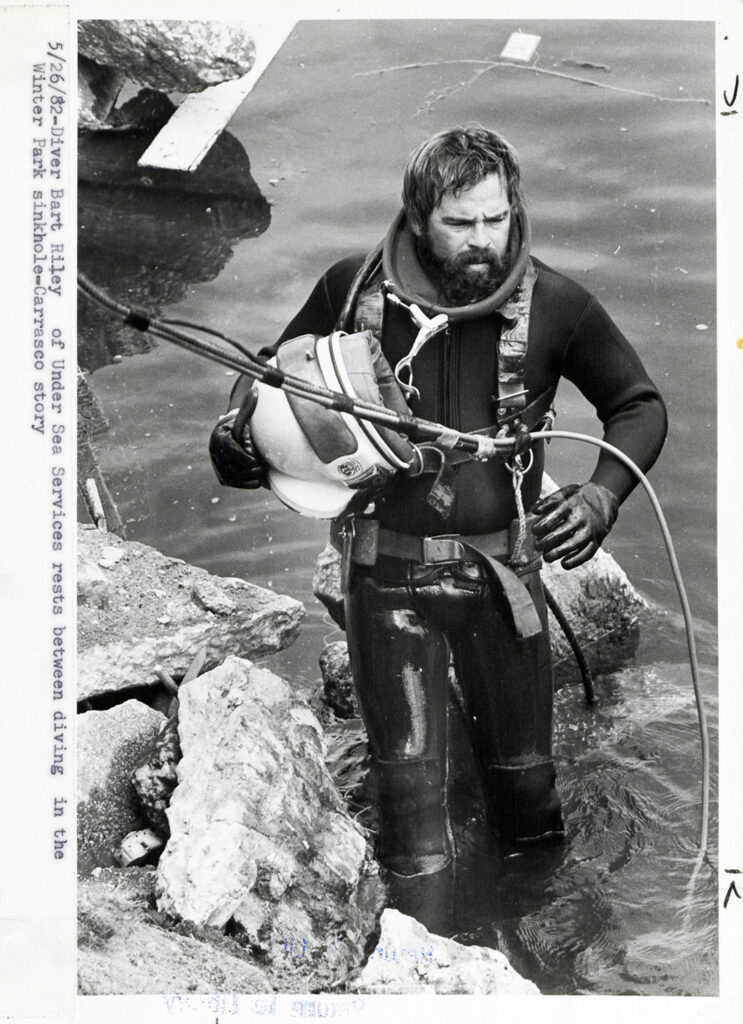
Divers worked inside the Winter Park sinkhole in the years following the collapse to recover items and map the crater floor. Orlando Sentinel Collection.
In 1982, divers were already working below the surface of the crater to map the bottom and recover items lost in the collapse. One Orlando Sentinel photograph shows diver Bart Riley partially submerged in the water while assistants managed safety lines from the unstable edge above him. At the time, the water was still so murky that one diver reportedly compared it to diving in “tomato soup.”
By the late 1980s, researchers had begun documenting something unexpected—the sinkhole was becoming a functioning lake ecosystem. At a conference sponsored by the North American Lake Management Society, University of Central Florida biologist John Osborne and other scientists presented research showing how the site had evolved from sinkhole to lake. Fish, aquatic plants, insects, and birds had all moved into the former disaster zone and made themselves at home.
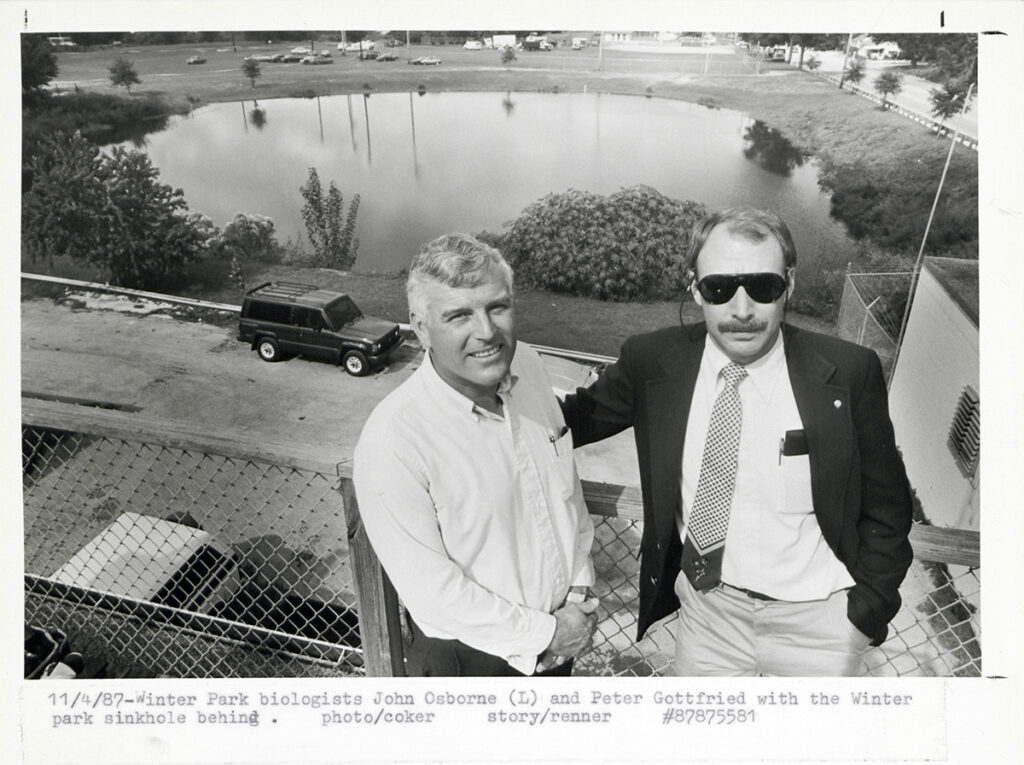
Researchers John Osborne and Peter Gottfried overlook the former sinkhole during research into the site’s transformation into a functioning lake ecosystem. Orlando Sentinel Collection.
Geologist Bill Wilson of Orlando-based Florida Sinkhole Research Institute described the transformation as “going from natural disaster to natural lake,” noting that the Winter Park sinkhole may represent a miniature example of how many Florida lakes originally formed.
Even then, however, some uncertainty remained. City officials debated whether the site should officially be considered a lake at all, and concerns lingered that the sinkhole could someday reopen. However, after a few close calls and much work to stabilize the site, the city relented and officially designated the former sinkhole as Lake Rose in 1987.
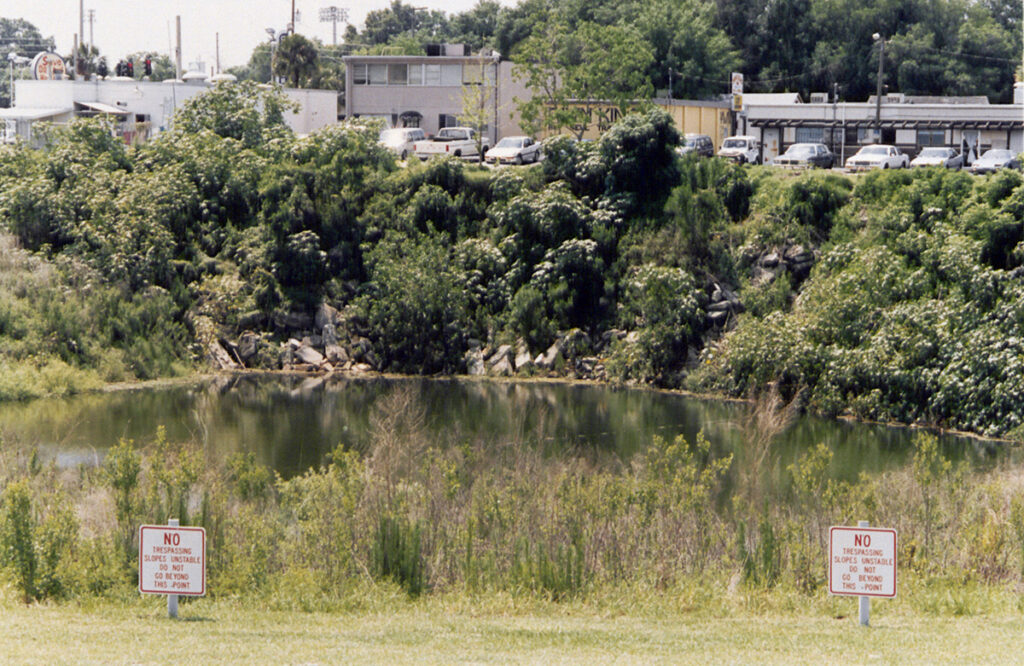
Lake Rose now occupies the former site of the Winter Park sinkhole.
Today, as some comments demonstrated, many people drive past Lake Rose without realizing they are looking at one of the most famous sinkholes in American history, a site where rumors, memories, and even a pair of long-lost Porsches still linger beneath the surface. Even people who remember the event may have lost track of where it happened.
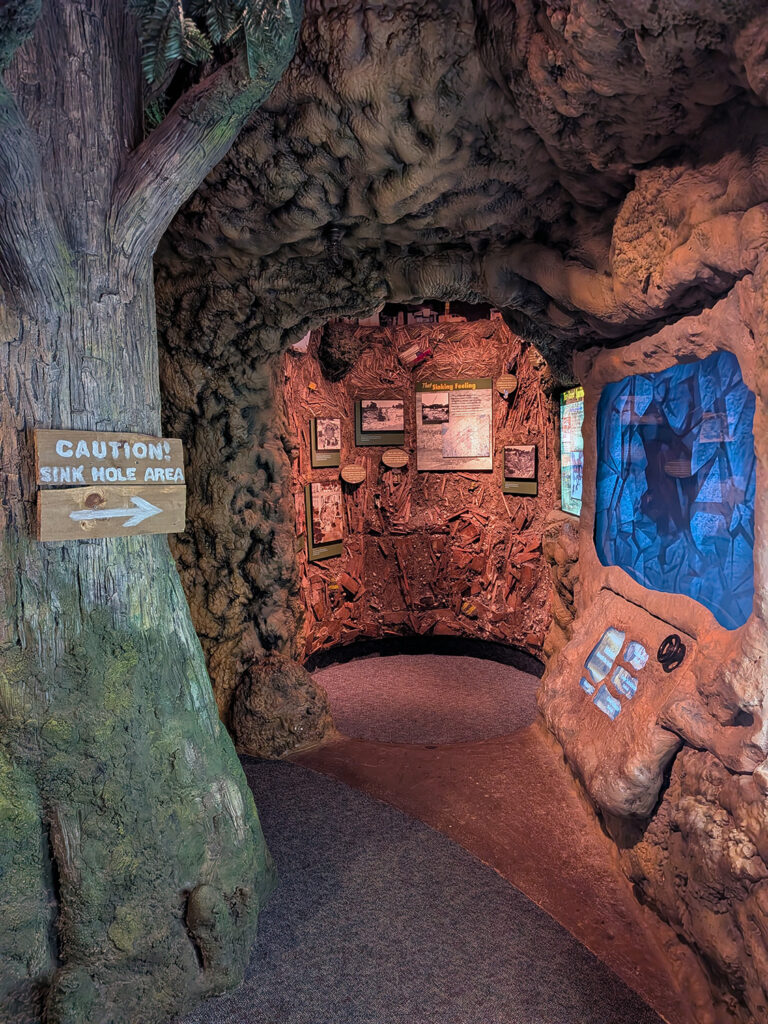
At the History Center, visitors can explore the science behind Florida sinkholes before walking through an immersive space that traces the story of the Winter Park sinkhole from collapse to lake.
Visitors interested in learning more about Central Florida’s geology and sinkholes can explore the Orange County Regional History Center’s permanent exhibition Natural Environment: Knowing Where We Stand, which features materials connected to the Winter Park sinkhole alongside the broader environmental history of the region.
The helicopters are gone, the souvenir stands have closed, and the sinkhole has transformed into a lake, but the story of the Winter Park sinkhole still hasn’t disappeared beneath the surface.
Note: Comments reproduced in the text have been lightly edited for spelling and punctuation. Screenshots reflect the original posts.