

By Bennett Lloyd, from the Spring 2026 edition of Reflections Magazine
In 1763, the British Empire finally achieved one of its long-standing goals: removal of the rival French from the great North American contest. The French and Indian War concluded in Britain’s favor, leaving it with French cessions from Quebec to Grenada. The kingdom of Spain also sported bruises, having lost Havana and Manila to the British after allying with its French Bourbon relations in the last year of the war. During treaty negotiations, these empires sought to settle rivalries and accounts. British control of the continent now extended to the Mississippi River. France gave its Louisiana Territory to Spain. And in exchange for the return of Manila and Havana, Spain gave its two Florida colonies, East and West, to Great Britain.
A Wild Legacy
By the time the British acquired the two Floridas, they had wracked the land with punishing slave raids, intense sieges, and the mercenary encouragement of Indian wars. Gone were the centralized polities of Native people clustered around priestly missions and hidalgo-founded ranches. What smallpox had not ravaged, the British had systematically burned. Their Muskogee-speaking allies – the same ones the British consistently paid to raid the Spanish frontier land – expanded into the area and intermarried with the scattered remnants of Florida’s original inhabitants long before its formal acquisition; the land was desolate enough that they called it “Seminoli,” a word that implies something wild, untamed, or uncultivated. The inherited Floridas were a far cry from the densely populated and linguistically diverse world Pedro Menendez encountered in 1565 when he founded St. Augustine, East Florida’s only surviving major city in 1763 and still its governing center.
To this city the crown of England sent skilled surveyors, naturalists, and entrepreneurs under the leadership of the new governor, James Grant. Now that they had Florida, what could they do with it? Much of England’s colonial wealth lay in the Caribbean, and the edicts of the time sought to establish Florida as a plantation-fueled economy in the Caribbean vein. The land grant system promised vast tracts of 20,000 acres to anyone who could start a productive town within two years, and the upper middle class and younger sons of minor nobility flocked to register their acreage. But what could they grow?
In Search of Answers
John Bartram made several trips to Florida from 1763 to 1773 as the crown’s official botanist for North America, partly to establish its climatic conditions and determine if its natural resources could be monetized. He took his son William with him, and a few of their early reports survive from before William Bartram’s 1791 publication of his famed Travels. John Bartram also relayed many of these observations to fellow famous naturalists such as Carl Linnaeus in Sweden. In the end, Florida became known for its timber – longleaf pines, bald cypress, and live oaks, all good for building structures and ships – and sugar and indigo became the go-to cash crops in the peninsula’s subtropical environment.
But even as the British sought to establish what there was in Florida, they also had to establish where things were. To accomplish this, the crown hired William Gerard de Brahm, a German-born surveyor, and gave him the difficult task of surveying the territory while also juggling individual surveys from dozens of land claims to be filed with the governorship. These expeditions even reached deep into Central Florida, where a metal-detected trade weight from 1765 highlights their presence as far inland as Seminole County, and De Brahm’s 30-foot-long map of Florida’s East Coast in the Kew Archive in London accurately depicts the shoreline of what is now Lake Harney.
On a later map from the 1780s, Lake Monroe is clearly visible (then named Lake Grant in honor of the governor), and Lake Jesup is visible as Lake Beresford, named for a land grantee who boasted a plantation farther downriver on a separate grant, also next to a lake named Beresford, which retains the name to this day. Grants were given and mapped, and small farmsteads or timbering camps established, from the eastern edge of the St. Johns to the Indian River and all along the coast. The watery highways connected them to the sawmills of Palm Coast and the administrative center in St. Augustine in a landscape where long-trodden footpaths and an ill-developed road system still could not accommodate wagons.
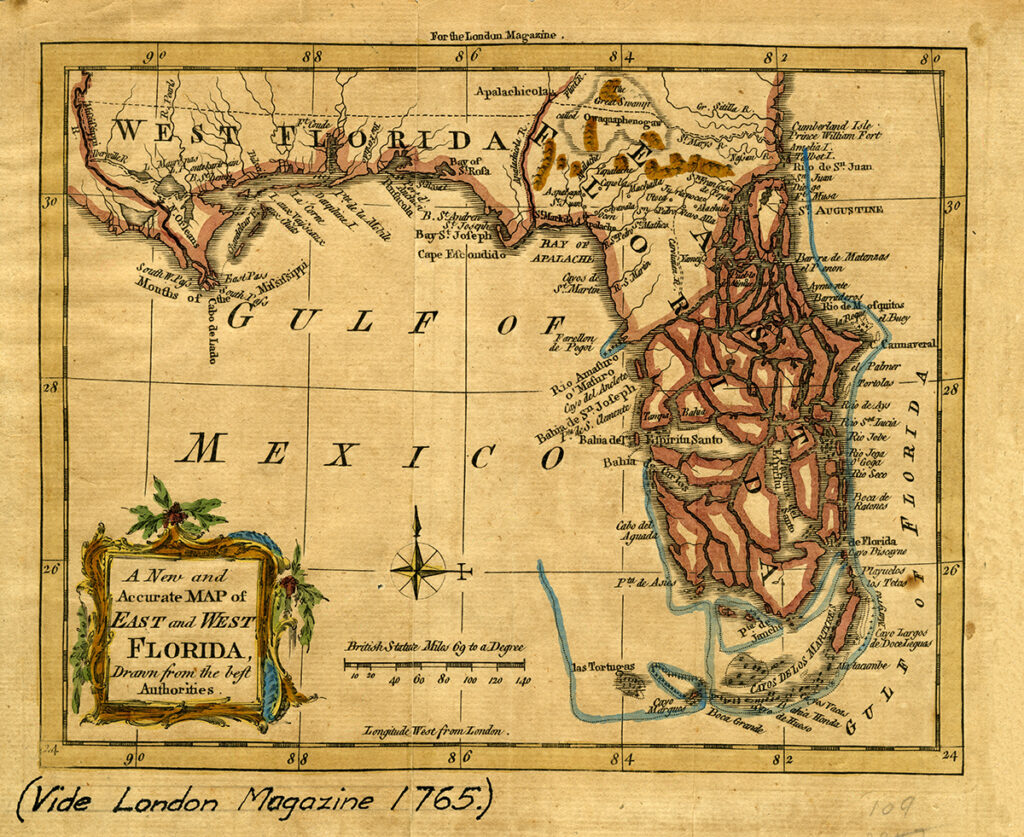
Map of East and West Florida from 1765 shows the British colonies established after the 1763 Treaty of Paris. Separated by the Apalachicola River, East Florida (capital, St. Augustine) covered the peninsula, while West Florida (capital, Pensacola) extended to the Mississippi River.
Britain’s Colonial Experience
The grand aspirations of the would-be planters usually fell short of reality. British colonists from the lower classes often abandoned the harsh environment of the organized plantation, struck out on their own, intermarried into Native society, accepted more lucrative plantation contracts in more developed areas, or fled to a larger city to apply their labors for their own profit.
The whining tones of East Florida planter Denys Rolle’s 1765 “Humble Petition” exemplify the experience of the majority of British grantees, slowly amalgamating tracts and pushing through repeated false starts and failures until they could petition the government for something more lucrative later on, provided their finances could survive the ordeal. In Rolle’s case, Parliament awarded him compensation for losses at his plantation along the St. Johns after the Revolutionary War and granted him islands in the Bahamas.
The experience of the Minorcan and Italian settlers under the harsh thumb of Andrew Turnbull offers the largest and best example of a “successful” East Florida plantation, but one that ended in tragedy.
Florida’s unpredictable weather and
the slave-like conditions of the indenture system took their toll on Turnbull’s 1,250 Mediterranean colonists, until some survivors marched to St. Augustine and forced the government to intervene and terminate their contracts during the upheaval of the Revolutionary War.
Loyal to the Crown
East and West Florida remained loyal to the British crown during that war, from 1775 to 1783. The two colonies were invited to send delegates to the Continental Congress but declined. The Caribbean as a block was more profitable and more proximal to British interests, more reliant on British ships and supplies, and therefore easier to control. British efforts to develop the Florida colonies in the Caribbean style paid off. But even as the war erupted, the would-be United States set its sights on Florida and Quebec as targets for conquest, fearing they would be launching points for British military campaigns to pincer the colonies back into submission.
In this way, the founding fathers always intended for Florida to become part of the United States, even if its inhabitants didn’t want to be. George Washington in particular saw Florida as an essential acquisition, noting its command of sea routes in the Gulf of Mexico and the Atlantic and the likelihood of hostile incursion on the continent from foreign armies and Indian-allied forces. He authorized five invasions of Florida throughout the Revolutionary War, but only the Spanish siege of Pensacola was a military success.
Overall, Spain aided the cause of the 13 rebelling colonies reluctantly, an ally only by proxy with France, holding onto its Bourbon grudge against Britain from 20 years before. What actions Spain took to aid the rebellion were made largely for its own self-interest. It trusted its new Anglo-American neighbor little more than it trusted its enemies, and for good reason. For a century, Spanish governors had watched the land-hungry settlers push boundaries farther to the west, north, and south in violation of their own treaties and proclamations. Many Georgians fighting now for independence were only one generation removed – if that – from the forces that had laid siege to St. Augustine in 1740. Regardless of the victor, Spain knew what was coming. It regained the Floridas in 1783, as part of the treaty that concluded the Revolution.
Florida and the New Nation
When Britain, Spain, and France nearly went to war again in the tumultuous years of 1790 through 1792, President George Washington pushed for neutrality but also did little to stop territories like Kentucky (which would become a state in 1792) from forming militia units to prepare for conflict. During this time, the United States developed a playbook that would serve it repeatedly as it expanded across the continent: sneak settlers into territories outside the official claims of the United States (often as organized militia units), seize or establish a fortification, declare an independent republic, and petition the U.S. for recognition and acceptance. A former soldier named John Pope traveled into Louisiana and Florida during this time frame, sketching forts and feeding intelligence to those militia units while he wrote his 1792 travelogue, A Tour through the Southern and Western Territories. Years later, it would become an invaluable resource for historians.
The attempt to send Kentuckian soldiers down to seize power and “declare independence” was thwarted by Spain’s Native allies, who warned the Spanish about the threat. This only delayed the inevitable, and armed revolts, invasions, and attempted annexations in the Floridas occurred in 1810, 1812, 1816, and 1817 before the United States successfully pressured Spain into selling the territory in 1819. George Washington’s fears about Britain using Florida as a base of operations for reinvasion of the United States would be realized during the War of 1812, when the British and their allied Creek and Seminole forces used Florida as a base of operations and a place for safe retreat when raiding the United States. The British built several forts in the Spanish territory, and even gave them to their allies at the conclusion of the war in 1816, most famously the “Negro Fort” at Apalachicola. Andrew Jackson’s bombardment of it in 1816 would lead to the First Seminole War.
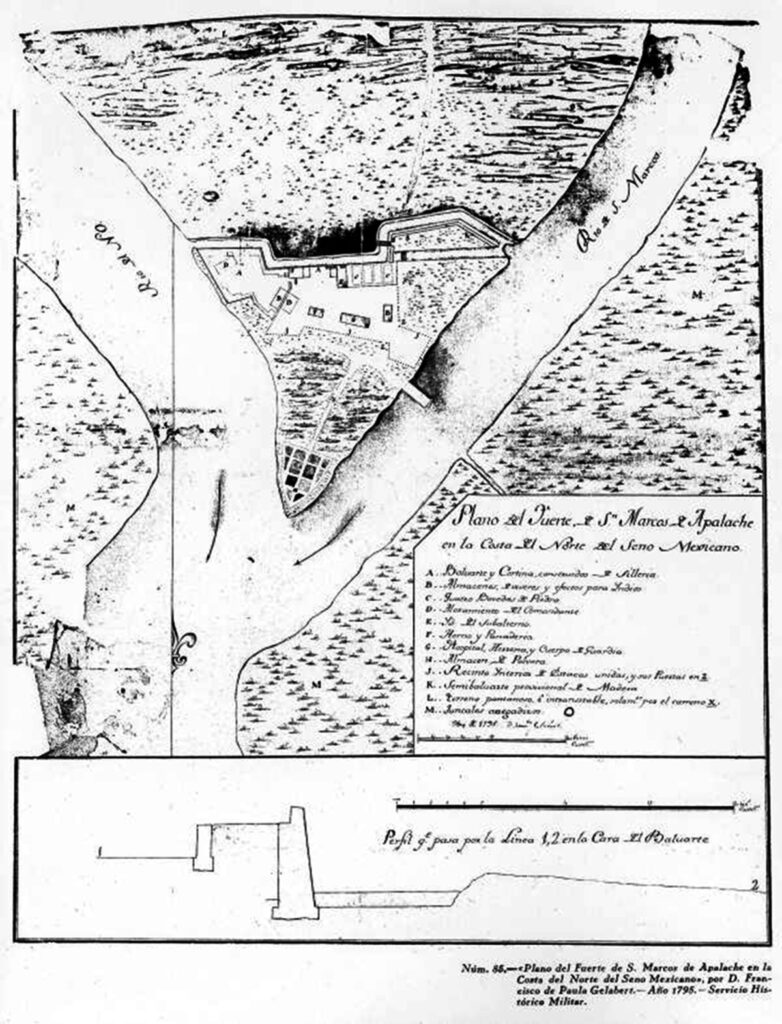
Map of Spain’s San Marcos de Apalache, attacked by Gen. Andrew Jackson in 1818.
Florida Schemes and Dreams
Founding fathers other than Washington wrote about Florida, and even came up with schemes to annex it. The founders saw Florida as necessary for national security, for trade, and for expansionist settlement. This view prefigured the idea of Manifest Destiny, a word not coined until the mid-19th century, which saw the United States as divinely preordained to expand across the whole of the North American continent. James Madison attempted to supersede congressional authority in 1810 after the revolt in West Florida declared a “republic” in territory east of the Mississippi and north of New Orleans. Madison ordered the territory’s annexation by proclamation while Congress was out of session, setting a precedent that Congress later upheld, even funding an additional attack on East Florida with support of the U.S. Navy at Fernandina, Amelia Island, and St. Augustine. The scheme fell apart after slow progress prompted intense scrutiny by opposing forces in the nation’s capital and a prolonged international outcry by the Spanish, which prompted Madison to withdraw his support for the operation.
One of the founders, Alexander Hamilton, was born in the Caribbean and spent part of this childhood there and identified more with subtropical Florida than many of his compatriots. Hamilton saw Florida as essential to the United States for trade, and he wrote consistently about the need for its acquisition from Spain, whether through purchase, treaty, or conquest, so that the U.S. could more easily access the rich markets of his home region. He also insisted that it never revert back to the British authority, still considered a real danger if the powers went to war again: estimates from the period guessed that Spain had fewer than 300 soldiers in the whole of the eastern territory.
Thomas Jefferson likewise saw Florida as an American birthright. At the behest of Hamilton, he tried unsuccessfully to badger Spain into including it in the Louisiana Purchase. Spain and France signed the Treaty of San Lorenzo in 1795 to settle the boundary between the two, but the secret Treaty of San Ildefonso in 1800 muddied the waters. Spain was authorized to manage French Louisiana, and France promised it would trade the territory for Spanish-held Tuscany. When Napoleon Bonaparte sold Louisiana to the United States instead, Jefferson tried to push the boundaries of the territory as far as they could go, only narrowly avoiding an outbreak of war over the dispute. James Monroe, the last living founding father, was intimately involved in James Madison’s annexation schemes as secretary of state. He finally oversaw Florida’s inclusion as a U.S. territory during his presidency with the 1821 implementation of the pivotal Adams-Onis Treaty of 1819.
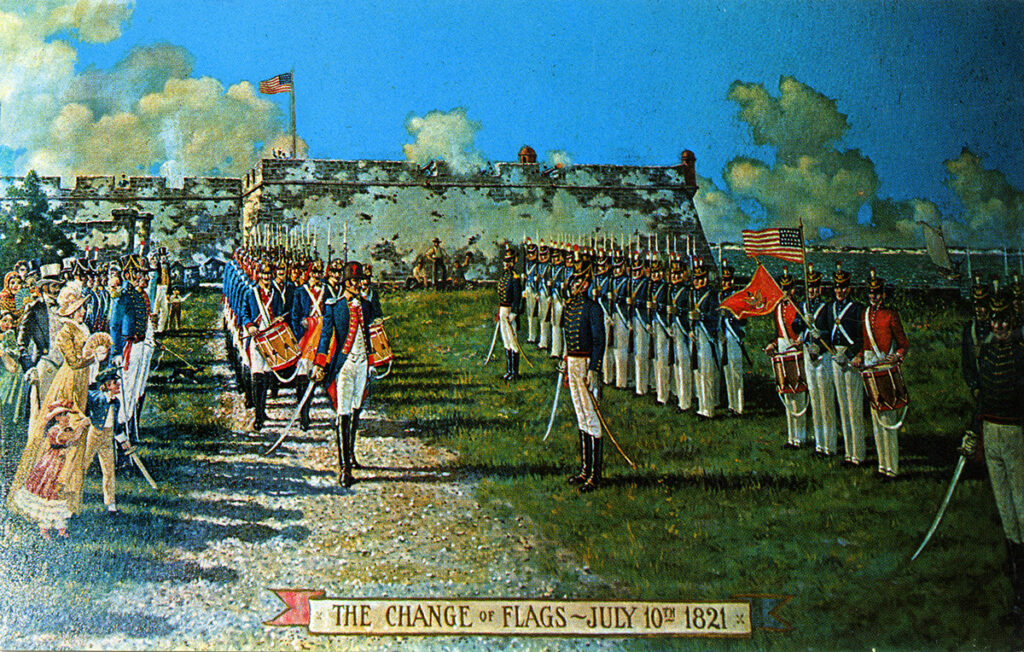
The change of flags, July 10, 1821, at Castillo de San Marcos in St. Augustine, Florida.
In spite of Britain’s relatively short-lived administration of the Floridas, the United States territory that emerged in the aftermath of the Adams-Onis Treaty was decidedly British and followed the Anglo-American inspired model of the land-grant plantation. The United States upheld the land-grant system, and the plantation settlements that slowly percolated down the peninsula finally achieved economic success under the system of chattel slavery as practiced in the American South – that is, echoing Turnbull’s Smyrna colony, planters could finally turn a reliable profit but only at the expense of human freedom. Cotton, tobacco, sugarcane, and cattle began flowing northward and filling the pockets of American investors. Settlers who could not break into the upper echelons of society in states farther north could bring their resources down to Florida and create their own upper-crust life here. And the inexorable march of land-hungry settlers crept into Seminole-reserved territories until Indian wars once again raged across its landscape. Ironically, the long-held vision of British Florida finally came to pass under American governance.