
By Rick Kilby from the Fall 2025 Edition of Reflections Magazine
The infamous Great Freeze of 1894-1895, which devastated the Orlando area’s citrus crop, was an enormous setback for the young city. It took fifteen years to recover, but Orlando’s population still doubled from 1910 to 1920, to over 20,000. The route of the Dixie Highway, right through the heart of downtown, made Orange Avenue and the blocks adjacent to it valuable commercial real estate. As a result, many new immigrants to the City Beautiful found their fortunes on Church Street, west of Orange Avenue.
According to a 1935 newspaper column by W.R. O’Neal, the commercial corridor on Church Street dates to 1880, when W.G. White “ventured into the woods and erected a building at the corner of Church and Orange” that “immediately established a trading center.” A.H. Birnbaum opened a dry goods store across the street with the finest ladies’ apparel south of Savannah and a saloon in back. Birnbaum, among the first of many Jewish merchants in downtown Orlando, was a member of the city’s first fire department and was elected alderman in 1886.
Other early Jewish merchants included Jacob Cohen, who bought a store in 1873 and in 1875 helped write the city charter, and the Bermans – Nat, who came from Russia and met his wife, Pauline, in Jacksonville. In 1908, they settled in Orlando, where they ran several businesses, including Berman’s Ready to Wear at Garland and Church, and were integral in founding two Jewish congregations. Pauline Berman was a powerhouse; she had her own radio show from 1930 to 1933 and was among the nation’s first women radio news commentators.
Harry Kanner, another important Jewish merchant on Church Street, came to Orlando from Romania in 1905 and operated a general store until 1932. William Berkovitz also came from Romania; he sailed on the Lusitania on its last transatlantic voyage before being sunk by U-boats in World War I. Berkovitz owned the Williams Department Store on Church Street and expanded to four other locations.
Gales Clothing Store, featured in a prior issue of Reflections, was an example of a Jewish-owned business that operated well into the second half of the 20th century on Church Street west of Interstate 4, serving a primarily Black clientele in the Parramore neighborhood.
Sam Teele, who came to Orlando from Greece, owned several popular downtown eateries, including Sam’s Place, a restaurant and pool hall in the building he erected in 1924 just west of the railroad tracks on Church Street. Teele was much beloved for never letting anyone who came to his restaurant go hungry, whether they could pay the bill or not.
German brothers Edward and Burchard Kuhl immigrated to the United States and settled in Orlando in the late 19th century after a stint in Mississippi. Edward Kuhl operated a general store at 25 W. Church St., which he owned with business partner and future mayor James L. Giles. Burchard also operated a popular candy and ice cream shop on Church Street.
Englishman Joseph Bumby and his family arrived from London in 1873 and homesteaded on 160 acres in what is today dubbed “The Milk District.” Bumby sold hay, grain, and fertilizer from a warehouse on West Church Street that was used as a depot after the railroad arrived in 1880. He became the railroad’s first ticket agent, utilizing skills he had honed while working for a railroad in England. In 1886, he built a hardware store on Church Street, founding a business that was open until 1966 – an 80-year run of continuous operation.
Historically, the unofficial dividing line between the white and Black communities of Orlando was Division Street, especially after city leaders began systematically to segregate the Black community in the 1920s. A notable exception was the West Church Street business of J. A. Colyer, a Black tailor who built a two-story structure close to Orange Avenue in 1911. It was used as a bakery, dry goods store, drugstore, and Colyer’s tailor shop. Colyer was the only Black landowner in downtown Orlando at that time, and both Black and white merchants mourned his untimely death in a car accident in 1930.
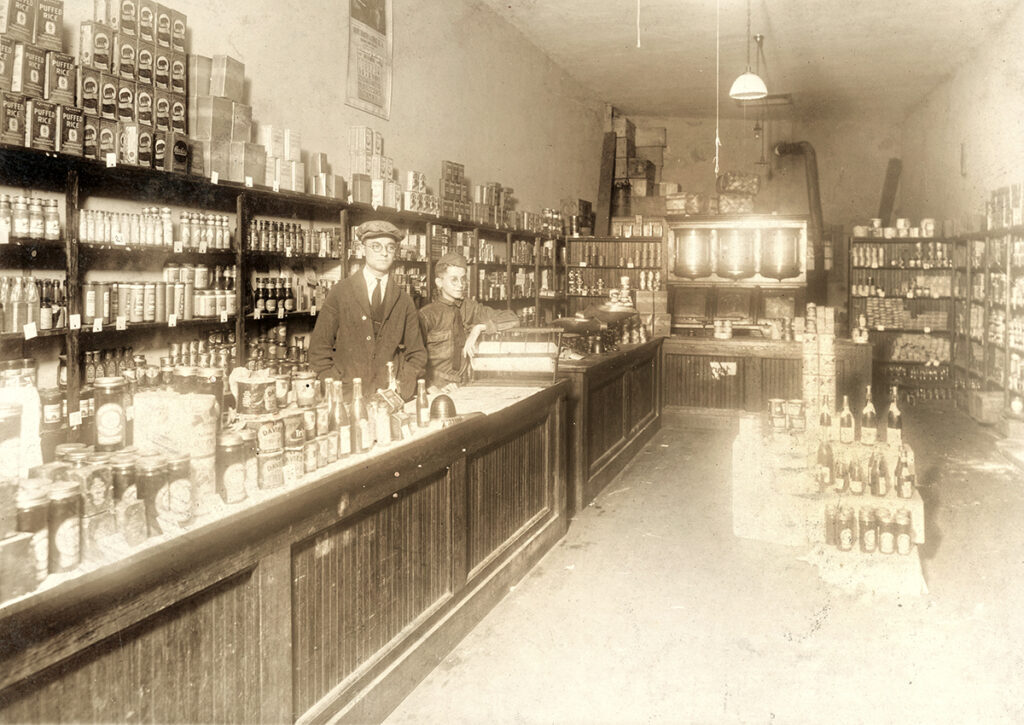
Dave Hillman Dry Goods Store on West Church Street, 1921.