
By Maleeha Fatima, 2026 University of South Carolina Oral History Fellow
Through the generosity of a donor, the Orange County Regional History Center offers two paid summer fellowships through the University of South Carolina’s graduate public history program. Fellows work virtually with the museum’s oral history collection while learning about other museum departments and careers. Each fellow also writes an essay placing their oral history work in context.
From the 1980s to the 2010s, while driving down Central Florida’s tourist corridors, it would be easy to skim past the endless rows of T‑shirt stands, discount ticket booths, postcard stores, and souvenir shops. They might seem like inevitable background noise to the real tourist attractions of Central Florida. But these fluorescent storefronts are tied to an intricate history of the tourism boom that began in the Orlando area in the 1970s. For decades, many of these stores have been owned or run by South Asian immigrant families – people whose personal histories stretch from India, Pakistan, Bangladesh, and neighboring regions to the heart of Central Florida’s tourism industry. Immigrant stories, like that of Nadeem Khan and his family, help us see patterns that might otherwise stay hidden.
Paths to Central Florida
The roots of South Asian settlement in places like Central Florida reach back to mid‑20th century migration. After the end of British rule and the Partition of India and Pakistan, millions of families were displaced or pushed to move. Some, like Khan’s parents, left India for Pakistan; others stayed in India and later migrated again, often to the United Kingdom, Canada, or the United States in search of work and stability.
For many South Asian immigrants, migration followed two broad pathways. After 1965 immigration reforms in the United States, many arrived as highly skilled professionals, including physicians, engineers, scientists, and academics, while others worked in factories, drove taxis and buses, or entered hospitality and family-owned retail businesses before achieving upward mobility. Khan’s father followed a similar path. After moving from Karachi, Pakistan, to England, he took on difficult industrial work in a television factory before saving enough to open Gala Shoes, a small shoe shop.
The promise of Florida
As late‑20th‑century America shifted toward a service and tourism economy, the Sunbelt states, including Florida, became especially attractive. Florida promised warm weather, a growing population, and, in the case of Central Florida, a tourism industry that was exploding after the opening of Walt Disney World in 1971.
In 1979, after a vacation trip that took them through Miami, Walt Disney World, and a then‑sleepy Kissimmee, the family decided to relocate permanently to the Orlando area despite Khan’s strong reluctance to leave England. Within a few years, helped by a recession-era opportunity offered by a Hungarian immigrant who owned several stores, his father reinvested their savings into a new wave of tourist gift shops in Kissimmee and Orlando, launching the decades‑long Central Florida chapter of the family business.
Opportunity along tourist corridors
By the late 1970s and 1980s, Orlando and Kissimmee were rapidly changing. New hotels, motels, and roadside souvenir shops appeared along U.S. Highway 192 and other major routes feeding into the ever-expanding amusement parks. These shops sold items including T‑shirts, beach towels, postcards, plastic alligators, and, when licensing allowed, Disney‑themed items. Over time, the Khan family’s business grew to more than twenty shops. Nadeem Khan believes his father was among the first people of Indian descent to run such stores in the area; later, more South Asian families entered the same line of work.
The Orange County Regional History Center’s oral history with Khan reveals how his family’s shops were distinctive at every stage of their journey, blending immigrant enterprise with carefully chosen retail strategies. Unlike many chains, they deliberately gave each shop a different name, so if a tourist didn’t find what they wanted in one, they wouldn’t assume the next store “with the same sign” had the same limited selection.
Their real edge was owning the properties outright rather than paying rent, thanks to Khan’s father’s knack for real estate. He would buy buildings, develop them, and use them as the backbone of the retail operation, including a motel in Kissimmee. At the product level, the Khan family’s shops carried the full spread of classic Florida souvenirs such as towels, trinkets, and licensed Disney items, positioning themselves as one‑stop shops for tourists. Disney‑licensed Mickey ears and hats, in particular, once made up a major part of their sales.
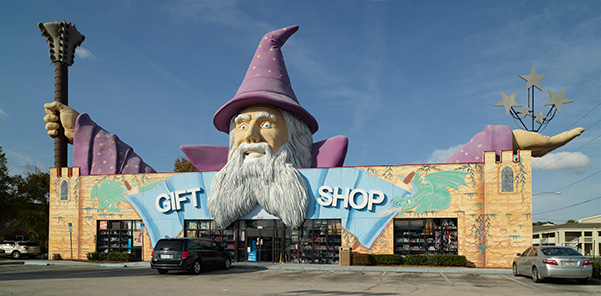
The iconic Magic Castle Gift Shop located on US 192 in Kissimmee. Courtesy of the Library of Congress.
Market shifts and corporate control
Over time, challenges to the family’s shops came from market shifts as well as Disney’s growing control. Khan acknowledges that much of the merchandise was low‑quality – “wash it once and it falls apart” tourist gear, as he describes it – a problem common among roadside shops. As years passed, Disney steadily tightened its licensing, pulling key items such as Mickey Mouse ear hats from outside retailers, which “put a major dent in people’s income” because they were top sellers. Disney also expanded its own retail operations through Downtown Disney and, later, Disney Springs. Khan characterizes the complex as essentially a mall where Disney reserved its best‑designed, higher‑quality merchandise for its own stores, leaving independent retailers with more generic products.
Eventually Khan exited the trade entirely, leaving just one shop in the family, across from Old Town in Kissimmee. With its eye‑catching Elvis display, it remains the last remnant of his father’s once‑sprawling local retail empire. In stepping away from the business, Nadeem Khan closed a defining chapter in his family’s Central Florida immigrant story and turned his attention to the creative and community interests he had always pursued alongside the family business.
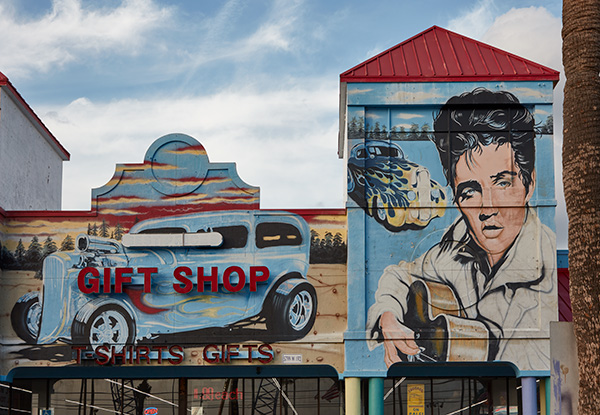
The Wound ‘n Around Gift Shop on US 192 in Kissimmee. The gift shop features a mural of Elvis Presley on the exterior. Courtesy of the Library of Congress.